
Free Resources
Three Guides From 10+ Years of Commercial Growing
Everything here comes from direct experience growing plants commercially since 2013. No filler, no affiliate recommendations — just the things that actually matter when you're trying to grow well. All three guides are free and open below.
Most first grows don't fail because the grower lacked talent. They fail because nobody told them the handful of things that actually matter early on. You don't need a perfect setup. You need to avoid the things that kill plants.
Overwatering — The #1 Killer of First Grows
Watering every day because the plant "looks thirsty." New growers water on a schedule instead of reading the plant. Cannabis roots need oxygen — sitting in wet soil suffocates them.
What actually happensRoots can't breathe, root rot sets in, leaves droop and yellow, the grower thinks the plant needs more water, and the death spiral begins.
The fixLift the pot. If it's light, water. If it's heavy, wait. Stick your finger an inch into the soil — if it's damp, leave it alone. In the first few weeks, you might only water every 3–5 days depending on pot size and environment. When you do water, water thoroughly until you see 10–20% runoff from the bottom, then don't touch it until the pot is light again.
Bad Soil or No Drainage
Using garden soil from outside, cheap topsoil from a hardware store, or a container with no drainage holes. Cannabis needs airy, well-draining growing media.
What actually happensRoots can't expand properly. Water pools at the bottom. Root rot, fungus gnats, and slow growth follow. The plant stays small and stunted, and the grower assumes they have a "bad seed."
The fixUse a quality cannabis-friendly potting mix with perlite, peat, or pumice mixed in — you want it to feel light and fluffy, not dense and muddy. Every container needs drainage holes at the bottom. No exceptions.
Not Enough Light
Trying to grow on a windowsill, using a cheap low-quality LED (the kind with purple/pink light that floods budget marketplaces), or placing the grow light too far from the plant. Cannabis needs significantly more light than most houseplants — insufficient light is the most common reason for stretchy, airy buds.
What actually happensThe plant stretches tall and thin reaching for light instead of growing bushy and dense. Buds stay small, loose, and airy at harvest — no amount of good genetics or nutrients compensates for bad lighting.
The fixOutdoor: Full direct sun, 6+ hours minimum, 10+ hours ideal for vegetative growth. South-facing exposure in the Northern Hemisphere.
Indoor: Get a quality LED from a reputable brand (HLG, Spider Farmer, Mars Hydro, AC Infinity). For a 2x4 tent, aim for 200+ watts actual draw. For a 4x4, 400+ watts. Follow the manufacturer's height recommendations — most LEDs should be 18–24 inches from the canopy during flower.
Ignoring pH
Watering straight from the tap without checking or adjusting pH. Cannabis has a specific pH range where nutrients become available to the roots. Outside that range, the plant starves even if you're adding plenty of nutrients — this is called nutrient lockout.
What actually happensMysterious deficiency symptoms show up even though you're feeding properly. Leaves yellow, spot, curl, or brown in patterns that don't match any simple diagnosis. The grower starts throwing more products at the problem, but the root cause is pH.
The fixGet a pH pen ($15–$30). Test your water after mixing in nutrients and adjust before you water. For soil, target 6.2–6.8 pH. For coco or hydro, target 5.5–6.5 pH. Check runoff pH occasionally too — if it's drifting far from your input, you may have salt buildup.
Poor Airflow and No Exhaust
Growing in a closet or tent with no fan and no ventilation. Cannabis needs fresh air exchange, gentle stem movement, and humidity management — especially in flower when dense buds become mold magnets.
What actually happensStagnant air leads to humidity pockets forming around the buds, then mold and powdery mildew take hold, and you lose part or all of your harvest right at the finish line.
The fixKeep an oscillating fan moving air across the canopy — stems should gently sway, not bend over. Use an exhaust fan to pull stale air out and bring fresh air in.
Temperature and humidity work together — managing one without the other causes problems. Here are the paired targets by stage:
| Stage | Temperature | Humidity |
|---|---|---|
| Seedling | 75–78°F | 65–70% |
| Vegetative growth | 77–82°F | 50–60% |
| Flower | 75–80°F | 45–50% |
| Late flower | 70–78°F | 40–50% |
Not Planning for How Your Strain Actually Grows
Jumping into a grow without researching how the strain behaves — how tall it gets, how long it flowers, how it responds to your environment. Every strain has a growth pattern, and if you don't plan around it, you'll spend the whole grow reacting instead of managing.
What actually happensThe plant stretches into the lights because you didn't flip to flower early enough. Or it takes 12 weeks to finish when you were expecting 8. Or a mold-prone strain falls apart in your humid climate because you didn't know to look for that.
The fixBefore you plant, learn your strain. Sativa-dominant plants can double or triple in height during the flowering stretch — flip to flower when the plant is smaller so it finishes at the right height. Autoflowers are a great option for limited space, but don't assume every autoflower stays small.
For outdoor grows, match the strain to your climate. Mold-resistant strains with open bud structures handle humidity much better than dense varieties. Check the expected finish time — a strain that needs until late November won't work if your first frost hits in October.
Ready to choose your strain? Use the strain guide to filter by environment, type, and experience level.
Use the Strain Guide →This guide is for educational purposes only and is not professional agricultural or legal advice. Cannabis cultivation laws vary by jurisdiction. Always verify applicable laws before growing. © 2025 Triangle Seeds.
Most indoor growers dial in their setup by feel. That works until it doesn't — an inconsistent harvest, a random mold issue, a grow that just didn't hit like the last one. The difference is almost always environmental precision. Every number here is stage-specific because what your plant needs in week 2 of veg is not what it needs in week 6 of flower.
New grower? Start here.
This guide gets technical — terms like VPD, PPFD, DLI, and EC are advanced concepts that experienced growers use to fine-tune their environment. If you're on your first or second grow, don't let the numbers overwhelm you. Focus on the basics: keep your temperature and humidity in the right range for each stage, give your plants enough light, and keep air moving. The tables here are a reference to grow into — not a checklist you need to master immediately.
Section 1 — VPD (Vapor Pressure Deficit)
VPD is the single best metric for understanding how your plant interacts with its environment. In plain terms, it measures how "thirsty" the air is — how much moisture the air can still absorb. It combines temperature and humidity into one number that tells you whether your plant can transpire (move water from roots through leaves) efficiently. When VPD is too low, the air is already saturated and the plant can't release moisture — growth slows and disease risk rises. When VPD is too high, the plant loses water faster than it can absorb it and starts to stress.
| Growth Stage | Leaf Temp | RH % | VPD (kPa) |
|---|---|---|---|
| Clones / Seedlings | 75–78°F | 65–75% | 0.4–0.8 |
| Early Veg | 75–80°F | 60–70% | 0.6–0.8 |
| Late Veg | 78–82°F | 50–60% | 0.8–1.2 |
| Early Flower (wk 1–3) | 78–82°F | 50–55% | 0.8–1.2 |
| Mid Flower (wk 4–6) | 75–80°F | 45–50% | 1.2–1.6 |
| Late Flower (wk 7+) | 70–78°F | 40–50% | 1.2–1.6 |
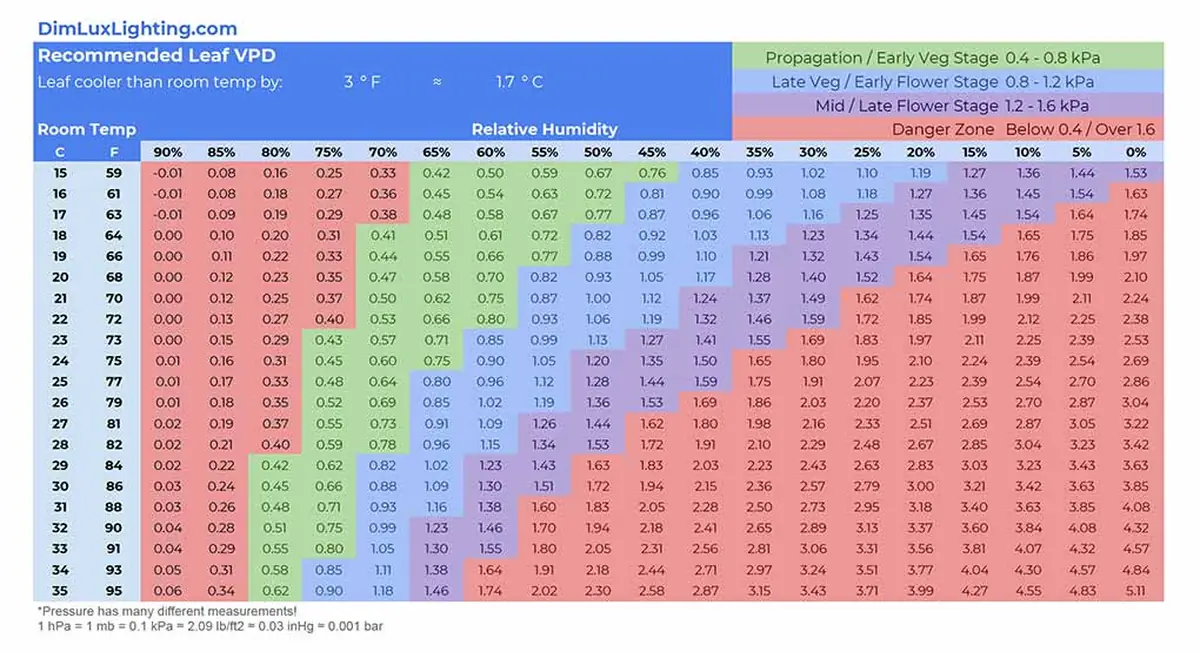
Common VPD mistakes:
- Measuring air temp instead of leaf temp. Leaves are typically 2–5°F cooler than air under LEDs.
- Running too-low VPD in flower. High humidity plus dense buds equals botrytis — keep RH below 55% from mid-flower on.
- Ignoring nighttime VPD. Temps drop, RH spikes, condensation forms on buds. Run your dehumidifier 24/7 in flower.
- Not adjusting nutrients to match VPD. Higher VPD means faster transpiration. If your VPD is high, run lower EC (electrical conductivity — the measure of nutrient concentration in your feed water) to avoid burning. If your VPD is low, you can push EC slightly higher.
Section 2 — Lighting: DLI and PPFD by Stage
Light intensity is the throttle for your grow. Too little means airy buds. Too much or too close means light burn and bleaching. Two terms worth understanding: PPFD (Photosynthetic Photon Flux Density) measures how much usable light is hitting your canopy at any given moment — think of it as the brightness your plant actually experiences. DLI (Daily Light Integral) measures how much total light the plant receives across an entire day, accounting for both intensity and how many hours the light is on. DLI is more useful as a target because it gives you flexibility — a lower-intensity light running longer can deliver the same daily dose as a brighter light running fewer hours.
| Growth Stage | PPFD | Photoperiod | DLI |
|---|---|---|---|
| Seedlings | 200–300 | 18/6 | 13–19 |
| Early Veg | 300–500 | 18/6 | 19–32 |
| Late Veg | 500–700 | 18/6 | 32–45 |
| Flower (no CO2) | 600–850 | 12/12 | 26–37 |
| Flower (with CO2) | 850–1100 | 12/12 | 37–48 |
| Ripening (final 2 wk) | 600–800 | 12/12 | 26–35 |
- PPFD drops with distance — a 6-inch height change can mean a 20–30% intensity difference. Use a PAR meter or phone app to map your canopy.
- LEDs produce less radiant heat than HPS, so leaf temps run cooler. You may need to run your room 3–5°F warmer to hit the same VPD.
- Ramp down PPFD in the final 2 weeks. Dropping intensity during ripening reduces stress and can improve terpene and resin quality.
Section 3 — Airflow, Exhaust, and CO2
Plants need CO2 at the leaf surface to photosynthesize. Still air creates a boundary layer of depleted CO2 around the leaf. In flower, stagnant air is the #1 cause of bud rot.
- Air exchange: Replace total room volume every 1–3 minutes.
- Oscillating fans: 1 above canopy, 1 below for under-canopy circulation.
- Target velocity: 1–2 m/s at the top of the canopy. Stems should gently sway — if leaves are flapping aggressively, dial it back.
- Late flower: Never point a fan directly at buds. Direct wind on dense colas can cause wind burn and foxtailing (where buds develop elongated, irregular growth instead of filling out normally).
CO2 supplementation (if you run it): Only worthwhile above 800+ PPFD. Target 1,000–1,200 ppm during lights-on. Seal the room — running CO2 with your exhaust fan on is just venting money outside.
Section 4 — Temperature and Plant Steering (Advanced)
This section covers techniques most growers don't use until they have several grows under their belt. If you're still getting your environment dialed in, skip this for now and come back to it later.
The gap between your daytime and nighttime temperatures — called DIF, short for "differential" — has a direct effect on how your plant grows. A warmer day relative to night encourages the plant to stretch taller. A cooler day relative to night (or equal temperatures) suppresses stretch. Most growers don't manipulate this intentionally, but understanding it helps explain why plants in the same room can behave differently across seasons as your ambient temps shift.
- Positive DIF (day 5–10°F warmer than night): Encourages vertical stretch. Useful in early flower when you want the plant to fill the canopy.
- Negative DIF (night warmer than day by 2–5°F): Reduces stretch. Most effective during the first 3 weeks of flower.
- Late flower temp drop (last 2 weeks): Dropping nighttime temps to 60–65°F can trigger purple and blue coloring in strains with the genetics for it — and mildly stresses the plant into pushing more trichome production.
Master Cheat Sheet — All Numbers
| Parameter | Seedling | Early Veg | Late Veg | Early Flwr | Mid Flwr | Late Flwr |
|---|---|---|---|---|---|---|
| Temp day (°F) | 75–78 | 77–80 | 78–82 | 78–82 | 75–80 | 70–78 |
| Temp night (°F) | 68–72 | 68–74 | 68–75 | 68–74 | 65–72 | 60–68 |
| Humidity | 65–75% | 60–70% | 50–60% | 50–55% | 45–50% | 40–50% |
| VPD (kPa) | 0.4–0.8 | 0.6–0.8 | 0.8–1.2 | 0.8–1.2 | 1.2–1.6 | 1.2–1.6 |
| PPFD | 200–300 | 300–500 | 500–700 | 600–850 | 600–850 | 600–800 |
| DLI | 13–19 | 19–32 | 32–45 | 26–37 | 26–37 | 26–35 |
See which strains match your indoor setup. Filter by environment, type, and experience level.
Use the Strain Guide →This guide is for educational purposes only and is not professional agricultural or legal advice. Environmental targets are general recommendations — optimal conditions vary by strain, phenotype, and growing system. © 2025 Triangle Seeds.
Most pest and disease problems come down to the same few mistakes — and they're almost always preventable. The single most important thing to understand is that prevention is exponentially easier than treatment. Once a pest population is established or a disease has taken hold, you're playing catch-up.
Understand the Disease Triangle
Every plant disease requires three things simultaneously: a susceptible host (your plant), a pathogen (fungus, bacteria, or virus), and a favorable environment (temperature, humidity, airflow). Remove any one side of this triangle and disease physically cannot develop.
This is the most powerful concept in plant health because it gives you three different angles of attack — and you have the most control over the environment.
Map Your Airflow
If you're growing indoors, buy an anemometer (a handheld wind speed meter — under $20). Walk your grow space and measure airflow at canopy level in every corner and between plants. You're looking for dead zones where moisture sits and disease thrives, and hot spots where fans blow too hard and stress leaves.
Outdoors, pay attention to plant spacing — crowded plants create their own stagnant microclimates.
Spray Micronized Sulfur Before Flowering Begins
A micronized sulfur foliar application in late vegetative growth does double duty: it kills russet mites (which are nearly invisible and often go undetected until damage is severe) and creates a preventive barrier against powdery mildew. Timing is everything — apply in the last week of vegetative growth before you flip to flower.
Always wear gloves and a respirator when handling micronized sulfur. Spray at the end of the day when temperatures are dropping to avoid leaf burn.
Stop Overwatering
Watering too frequently is the single most common mistake across all experience levels, and it's a direct path to root rot (Pythium). Waterlogged roots can't absorb oxygen, which weakens the plant's immune system and makes it susceptible to everything else on this list.
Let at least the top inch of soil dry out between waterings. Pick up your pots — learn what a dry pot feels like versus a saturated one. When in doubt, wait another day.
Inspect Weekly — Especially the Undersides of Leaves
Most pest problems are caught too late because growers only look at the tops of their plants. Spider mites, aphids, and whiteflies all colonize the undersides of leaves first. By the time you see damage on top — yellowing, stippling, curling — the population is already established.
Make it a weekly habit: flip leaves, check stems, look at new growth closely. A $10 jeweler's loupe (30x–60x magnification) turns invisible problems into obvious ones.
For Spider Mites: Deploy Persimilis Predatory Mites
Persimilis predatory mites are the most effective biological control for two-spotted spider mites. Release them 2–3 times over the course of 14 days to establish a population that hunts down and eliminates the spider mites. This is far more effective than spraying, which kills predators and prey alike and often leads to resistant populations.
Key timing: deploy before flowers develop. Once trichomes form, the predatory mites get stuck to the resin and can't do their job.
Treat Aphids Aggressively
Aphids reproduce at an alarming rate and can colonize an entire grow room in days. If you spot even a few, treat immediately. The key to aphid control indoors is rotating three organic sprays so they can't build resistance: Beauveria Bassiana (a fungus that infects and kills them), Azadirachtin (neem-derived growth disruptor), and M-Pede (insecticidal soap). Rotate on a 3–4 day cycle until the population is gone. Don't stop after the first spray — follow through.
Fungus Gnats: Dry Out the Soil and Use BTi
Fungus gnat larvae feed on roots and can seriously damage seedlings. They thrive in consistently moist topsoil. The fix is a one-two punch: let the top layer of soil dry out completely between waterings, and add BTi (Bacillus thuringiensis israelensis, sold as "Mosquito Bits" or "Gnatrol") to your water. BTi kills gnat larvae on contact but is completely harmless to plants, humans, and beneficial insects.
Prevent Botrytis (Bud Rot)
Botrytis attacks your biggest, densest buds right before harvest. It thrives when humidity exceeds 55% during flowering, especially in dense canopies with poor airflow. Prevention is everything: drop your relative humidity below 55% in the final weeks of flowering, defoliate to improve air circulation, and inspect dense buds regularly — if you see gray fuzz, remove the affected bud immediately and clean your tools.
Quarantine Everything That Enters Your Grow Space
The most common way pests enter an indoor grow is on new plants, clones, or on your clothes after visiting another garden. Any new plant should be quarantined in a separate area for at least 7 days and thoroughly inspected (including the root zone) before joining your main garden. Change clothes and wash hands before entering your grow space if you've been in another garden.
Quick Reference
Spider Mites
Persimilis predatory mites, 2–3 releases over 14 days, before flower
Aphids
Rotate Beauveria Bassiana, Azadirachtin, and M-Pede on 3–4 day cycle
Fungus Gnats
Let soil dry between waterings + BTi in water
Powdery Mildew
Micronized sulfur in late veg, maintain airflow
Botrytis / Bud Rot
Humidity below 55% in late flower, defoliate, inspect dense buds
Root Rot
Stop overwatering, let top inch dry, use fabric pots
Every Triangle Seeds strain is selected for resilience and real-world performance.
Browse All Seeds →This guide is for educational purposes only and is not professional agricultural or legal advice. Always follow product labels when using pest control products or biological controls, and consult a licensed professional for advice specific to your situation. By using this guide, you assume all associated risk. © 2025 Triangle Seeds.
More Growing Resources