
By Matt Spitzer | May 2026
The short answer is no. Outdoor cannabis, especially plants in the ground with established root systems, can often go days or even a week between waterings depending on rainfall, climate, and soil type. Many home growers water by hand their entire outdoor season and never feel the need for anything more.
But there’s a difference between what your plants need and what gives you freedom as a grower. An automatic watering system means you can leave town for a week, go through an unexpected dry stretch, or simply not think about watering every day. That peace of mind has real value, and once you’ve set up a basic drip system, you’ll wonder why you waited.
This guide covers when outdoor cannabis actually needs supplemental watering, how in-ground and container grows differ, and what your options are for automating or simplifying the process.
Quick Answer
| Setup | Needs Automatic Watering? | Notes |
|---|---|---|
| In-ground, established plants | Often no | Roots access deep moisture; rainfall usually sufficient |
| In-ground, young plants | Sometimes | Shallow roots dry out faster than you’d expect |
| Containers outdoors | Frequently yes | Dry out much faster than in-ground; heat accelerates this |
| Any setup during drought | Yes | Even established in-ground plants need help in prolonged dry spells |
| Any setup if you travel | Yes | Automation removes the risk entirely |
Table of Contents
- In-ground vs. container watering needs
- When automatic watering makes sense outdoors
- Irrigation options for outdoor cannabis
- How to set up a basic drip system
- Hand watering outdoors
- Reading your plants and soil
- FAQ
In-Ground vs. Container Watering Needs
The biggest factor in how often your outdoor plants need water is whether they’re in the ground or in containers.
In-ground plants develop deep root systems over time. Established roots can access moisture several feet below the surface, which means the plant can sustain itself through days or even a week without rain depending on your soil and climate. In many parts of the country, rainfall alone is enough to carry an in-ground grow through most of the season.
Two important caveats. First, young in-ground plants with shallow root systems behave more like container plants than established ones. For the first several weeks after transplant, the roots haven’t gone deep yet. The surface layer of soil around a young plant dries out faster than you’d expect, even when planted in the ground. Water young transplants more frequently until they’re established.
Second, drought happens. Even in regions with adequate seasonal rainfall, an unusual dry stretch of two or three weeks can stress established plants. Having a way to water when you need it, even if you don’t use it regularly, is worthwhile insurance.
Container plants outdoors are a different situation entirely. Fabric pots and other containers don’t have access to soil moisture below them. The entire root zone is confined to what’s in the pot, and that dries out based on plant size, temperature, and pot volume. A large plant in a 15-gallon fabric pot on a hot summer day can drink its container nearly dry within 24–48 hours. Container grows outdoors almost always benefit from some form of irrigation system, especially in warm climates or during summer heat.
See our pot size guide for how container volume affects watering frequency.
When Automatic Watering Makes Sense Outdoors
Automatic watering isn’t about what your plants strictly require. It’s about what level of involvement and risk you’re comfortable with.
You should consider automation if:
- You travel or work long hours and can’t water consistently
- You’re growing in containers where daily watering may be necessary at peak season
- Your climate is prone to dry stretches even during the growing season
- You want to run a drip system on a timer and check in on your plants rather than being tied to a watering schedule
- You’re growing more plants than hand watering is practical for
You can probably hand water if:
- Your plants are in the ground with established root systems
- You’re in a climate with reliable summer rainfall
- You’re growing a small number of plants and can check on them daily
- You’re comfortable adjusting frequency based on weather
The honest framing is this: hand watering works fine in a lot of scenarios. But a basic drip system on a timer costs very little, takes a few hours to set up, and removes a significant amount of risk from your grow. At Triangle Seeds we prefer drip irrigation for outdoor grows because it lets you set a baseline schedule and adjust as needed, rather than reacting to whatever the weather does.
Irrigation Options for Outdoor Cannabis
There are several ways to water outdoor cannabis, from fully automated drip systems to simple hand-triggered options. Here’s how they compare.
Drip Irrigation with a Timer
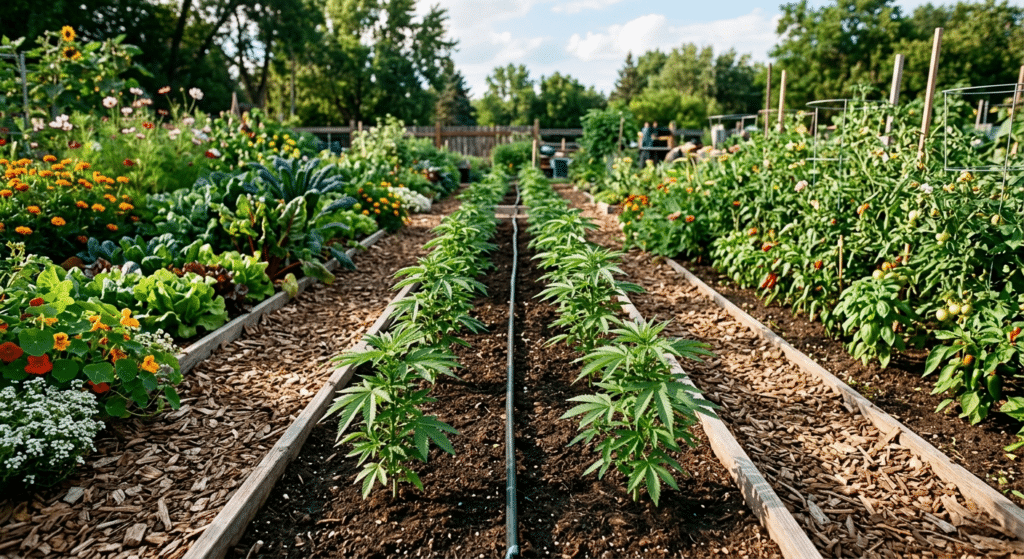
A timer-controlled drip system delivers water directly to the base of each plant through small emitter lines. You set the frequency and duration, and the system runs without any input from you.
Pros:
- Fully automated once set up
- Water goes directly to the root zone, minimizing evaporation and keeping foliage dry
- Reduces mold risk compared to overhead watering
- Easy to adjust frequency and duration as the season changes
- Works for both in-ground and container grows
Cons:
- Requires upfront setup time
- Emitters can clog or fail without regular checks
- Not ideal for very large in-ground plants that have spread their roots widely
This is the approach we use at Triangle Seeds. A basic hose-connected drip timer with individual emitter lines to each plant is enough for most home grows and is relatively inexpensive to set up.
Manual Drip System (No Timer)
The same drip emitter setup as above, but connected to a hose you turn on manually rather than a timer. You control when water runs but don’t have to move a hose around or hand water each plant.
Pros:
- Less expensive than a timed system
- Delivers water to the root zone efficiently
- Easy to expand or modify
Cons:
- Requires you to be present and remember to water
- Doesn’t help when you travel or get busy
A good middle ground for growers who want the efficiency of drip without the cost of a timer. Easy to upgrade to a timed system later by adding a hose timer.
Soaker Hoses
Soaker hoses are porous hoses that weep water slowly along their entire length. They’re laid along the base of plants and connected to a hose or timer.
Pros:
- Inexpensive and widely available
- Good for rows of in-ground plants
- Keeps water at soil level
Cons:
- Less precise than drip emitters for individual plants
- Can be difficult to manage for widely spaced plants
- Uneven water distribution if pressure or slope varies
Better suited to garden-style in-ground grows with multiple plants in rows than to scattered container plants.
Overhead Irrigation (Sprinklers)
Sprinklers deliver water from above, covering a larger area. Common in vegetable gardens but less ideal for cannabis.
Pros:
- Covers large areas easily
- Works for dense plantings of small or young plants
Cons:
- Wets foliage, which increases mold and powdery mildew risk
- Less efficient due to evaporation
- Not recommended for flowering plants
Overhead watering is most acceptable for young seedlings before significant canopy development. Once plants are in flower, keeping water off the buds is important. Transition to drip or hand watering at the base before flowering begins.
Hand Watering
Watering by hand with a hose or watering wand remains a reliable approach for smaller grows.
Pros:
- Zero setup cost
- Forces you to inspect plants closely every time you water
- Fully adjustable based on what you see
Cons:
- Time-consuming with more than a few plants
- Requires you to be present consistently
- Easy to skip when life gets busy
For growers with 2–4 plants in the ground and a climate with reasonable rainfall, hand watering is entirely sufficient. Add a soaker hose or drip system if you want flexibility without committing to full automation.
How to Set Up a Basic Drip System
A basic outdoor drip system for a home cannabis grow requires only a few components:
- Hose timer: Connects to your outdoor spigot and controls when water runs. Battery-powered timers are inexpensive and reliable. Set frequency and duration based on your plants’ needs and adjust as the season progresses.
- Mainline tubing: Half-inch tubing runs from the timer to your grow area. This is the backbone of the system.
- Emitter lines: Quarter-inch tubing branches off the mainline to each plant, ending in a drip emitter placed at the base of the stem. Emitters come in different flow rates (typically 0.5–2 gallons per hour). Match the flow rate to your plant size and container volume.
- Manifold or distribution head (optional): Splits one mainline into multiple outputs, making it easier to run lines to multiple plants from a single source.
Start with a conservative schedule (shorter run times, less frequent) and increase based on what your plants and medium tell you. Use the lift-the-pot method for containers and check soil moisture at 2–3 inches depth for in-ground plants before adjusting your timer. See our watering guide for more on reading moisture levels.
Hand Watering Outdoors
If you’re hand watering, a watering wand with a gentle shower head is the most practical tool for outdoor cannabis. It lets you water at the base of the plant without disturbing the soil surface or wetting the canopy.
Water in the early morning before peak heat. This gives roots time to absorb moisture before evaporation peaks and keeps foliage dry overnight, reducing mold risk. Avoid watering in the middle of a hot afternoon. Water droplets on leaves in direct sun can intensify heat and cause spotting, and much of the water evaporates before it reaches the roots.
For in-ground plants, water deeply and less frequently rather than shallowly and often. Deep watering encourages roots to grow downward, which makes plants more drought-tolerant and more stable structurally.
Reading Your Plants and Soil
No schedule or system replaces the habit of checking your plants regularly. Even with a drip timer running, inspect your plants every few days during the growing season.
For containers: Lift the pot. A light pot needs water. A heavy pot doesn’t. See our watering guide for the full lift-the-pot method.
For in-ground plants: Push a finger or a wooden dowel 2–3 inches into the soil near the base of the plant. If it comes out dry, it’s time to water. If it comes out with moist soil clinging to it, wait.
Watch the plants themselves: Slight drooping in the early afternoon on a hot day is normal and usually recovers by evening. Persistent drooping in the morning is a sign of stress, either from too little water or too much. See our yellow leaves guide if you’re seeing other stress symptoms alongside wilting.
If you’re planning your outdoor grow and still need seeds, browse our seed catalog or call or text us at (919) 410-6945. We’re happy to help you find genetics suited to your region and setup.
FAQ
Do outdoor cannabis plants need to be watered every day? Not usually. In-ground plants with established root systems often go several days between waterings, especially with any rainfall. Container plants outdoors can need daily watering during hot weather or peak flowering when plants are large and water demand is high.
Can I leave my outdoor cannabis plants for a week without watering? For in-ground plants in a climate with regular summer rain, possibly. For container plants, a week without water is too long in most conditions. A drip timer set to run every 1–2 days will keep containers adequately watered while you’re away.
What is the best irrigation method for outdoor cannabis? Drip irrigation with a timer is the most reliable option for most home growers. It delivers water directly to the root zone, reduces mold risk by keeping foliage dry, and can be automated so you’re not dependent on a manual schedule.
Is overhead watering bad for cannabis outdoors? It’s not ideal, especially during flowering. Wetting the buds and foliage increases the risk of mold and powdery mildew. Overhead watering is acceptable for young plants before canopy development but should be transitioned to drip or base watering once plants are established.
How do I know if my outdoor cannabis plant needs water? For containers, lift the pot. A noticeably light pot needs water. For in-ground plants, check soil moisture 2–3 inches below the surface. If it’s dry at that depth, water. Slight afternoon wilting on a hot day is normal. Morning wilting is a sign the plant needs water.
Do young outdoor cannabis plants need more frequent watering than established ones? Yes. Young transplants have shallow root systems that haven’t reached deeper soil moisture yet. Water young in-ground transplants more frequently, similar to how you’d water a container plant, until the roots are established and the plant shows vigorous growth.
About the Author

I’m Matt, co-founder of Triangle Seeds. I’ve been growing commercially since 2013 and started Triangle Seeds in 2017 with my business partner Chase. If you have questions about this post or want help choosing seeds for your grow, call or text me at (919) 410-6945. Learn more about Triangle Seeds.
We have a video series with cannabis content creator Catherine Goldberg, aka Senior Savvy Cannabis, where we guide her through her first indoor grow. If you are a new grower, you might find the videos helpful. Watch the grow videos →