
The labels were never about how the plant makes you feel. Here’s the real story.
Last updated: March 2026
If you searched “indica vs. sativa,” you probably wanted to know which one relaxes you and which one energizes you. That’s a fair question, and we’ll get to it. But the more interesting story is where those words came from in the first place, and why understanding that history makes you a better grower.
Table of Contents
- What People Expect From the Labels
- Where “Sativa” Came From
- Where “Indica” Came From
- Landrace Genetics and Why Geography Mattered
- What Happened When the Plants Met
- What the Labels Actually Predict Today
- What This Means for Your Grow
- Ready to Start Growing?
- Frequently Asked Questions
What People Expect From the Labels
Walk into any dispensary and you’ll hear the same shorthand: indicas relax you, sativas energize you, hybrids are somewhere in between. It’s been repeated so often it feels like botanical fact.
The experience people describe is real. The explanation for why isn’t quite what the labels suggest. The effects of any given cannabis plant have more to do with its specific cannabinoid and terpene profile than whether it leans toward one lineage or another. Two strains both labeled “indica” can produce very different experiences. Two strains from opposite ends of the indica/sativa spectrum can land similarly.
That said, the labels aren’t invented marketing. They have a genuine history rooted in plant science and geography. That history is useful, and for growers, it’s the more important part of the story.
Where “Sativa” Came From
In 1753, a Swedish botanist named Carl Linnaeus published a classification of the natural world that became the foundation of modern taxonomy. Among the plants he described was cannabis, a single species, which he named Cannabis sativa. The word “sativa” is Latin for cultivated, and the plants Linnaeus was working with were the tall, fibrous, narrow-leafed varieties grown across Europe and western Eurasia, primarily for textile fiber and rope.
These were essentially hemp plants in today’s terms: low in the compounds that produce intoxicating effects, bred for their strong stalks rather than their flowers. Linnaeus wasn’t describing a recreational drug. He was cataloging an agricultural crop.
For about thirty years, his single-species framework held.
Where “Indica” Came From
In 1785, a French naturalist named Jean-Baptiste Lamarck received plant specimens that had been collected in India. When he examined them alongside the plants Linnaeus had described, the differences were hard to ignore. These were shorter, bushier, more heavily resinous plants with broader leaves and denser branching. They looked different, they grew differently, and (as Lamarck noted with evident interest) they had a notably stronger effect on the people who used them.
He documented that the plant’s “principal virtue” was providing “a kind of intoxication that makes sorrow forgotten, and that gives forceful joy.” For a 1785 botanist, that was fairly colorful language. It was also the first time the psychoactive character of the plant made it formally into the scientific record.
Lamarck named these plants Cannabis indica: “indica” being Latin for “of India.” It was a geographic designation, describing where the specimens had come from, not a chemical or experiential category.
So from the very beginning, the indica/sativa distinction was about plant morphology and origin. Where it grew. How it looked. How it was structured. The effects piece came along for the ride, but it was never the scientific basis for the classification.
Landrace Genetics and Why Geography Mattered
The physical differences Lamarck noticed between his Indian specimens and the European hemp plants weren’t random. They were the result of thousands of years of adaptation to very different environments.
Cannabis sativa, as Linnaeus described it, had evolved in the temperate climates of Europe and Central Asia: tall, fast-growing, open-structured, bred over generations for fiber production.
Cannabis indica had adapted to the Hindu Kush mountain range, spanning what is now Afghanistan, northern Pakistan, and the Kashmir region. These are high-altitude environments with short, cold summers and harsh, variable conditions. The plants that survived there developed a compact structure, faster flowering cycles, and dense resinous buds, a natural response to a season that doesn’t last long enough for a slow-maturing plant to reproduce.
Meanwhile, across the equatorial belt (Colombia, Jamaica, Thailand, southern India, parts of Africa), entirely different cannabis populations had developed. These plants had all the time in the world. Long, warm seasons with consistent light meant no pressure to finish fast. They grew tall. They flowered slowly. Their buds were looser and more elongated, suited to environments where humidity was high and airflow mattered.
These geographically isolated populations are what botanists call landrace strains: cannabis that developed its traits naturally over generations in a specific place, without human crossbreeding. The Hindu Kush hashish plants. Colombian Gold. Thai sticks. Durban Poison from South Africa. Each was the product of its environment, genetically shaped by the specific climate where it evolved.
The indica/sativa distinction, in its original form, was essentially describing these two broad geographic lineages: the mountain strains of Central Asia versus the equatorial strains of the tropics.
For growers, this geography explains a lot. The Hindu Kush plants that became “indica” were built for short seasons and needed to finish before cold weather arrived. That’s still reflected in indica-dominant genetics today: shorter plants, faster flowering, suited to climates with limited growing windows. The equatorial plants that became “sativa” had no such urgency. They grew large, took their time, and developed structures suited to warm, humid air. That tendency still shows up in sativa-dominant genetics: taller plants, longer flowering times, airier bud structure that handles humidity better than dense indica flowers do.
What Happened When the Plants Met
For most of cannabis history, these lineages stayed geographically separate. The landrace strains of Afghanistan had no contact with the landrace strains of Colombia. The taxonomy, however imprecise, reflected something real about distinct plant populations.
That changed in the 1960s and 1970s.
The counterculture movement sent travelers through cannabis-growing regions of the world, and seeds came back with them. Hash plant genetics from Afghanistan ended up in grow operations in California. Thai and Colombian equatorial strains were crossed with faster-finishing Afghani genetics to create plants that could mature in a North American growing season. Breeders in Santa Cruz were crossing Colombian, Thai, and South Indian landraces to create what became the Haze family of strains. The result was the beginning of serious hybrid breeding.
Then prohibition pushed growing indoors, which accelerated crossbreeding further. Breeders selected for traits that mattered in a grow room: compact size, faster finish, high resin production. Those priorities leaned heavily on Hindu Kush genetics. But breeders also wanted the terpene complexity and experiential character that equatorial strains contributed.
Within a generation, virtually every commercial cannabis strain became a hybrid of these lineages. The plants that fill dispensary menus and seed catalogs today don’t come from isolated mountain villages or Colombian hillsides. They come from decades of intentional crossbreeding that blended both lineages deliberately.
Which means the strict indica/sativa distinction, as a precise botanical classification, largely stopped reflecting reality. Most botanists today classify all cannabis as varieties within a single species. The terms “indica” and “sativa” persist in the industry not as strict scientific categories but as shorthand for general growth tendencies.
What the Labels Actually Predict Today
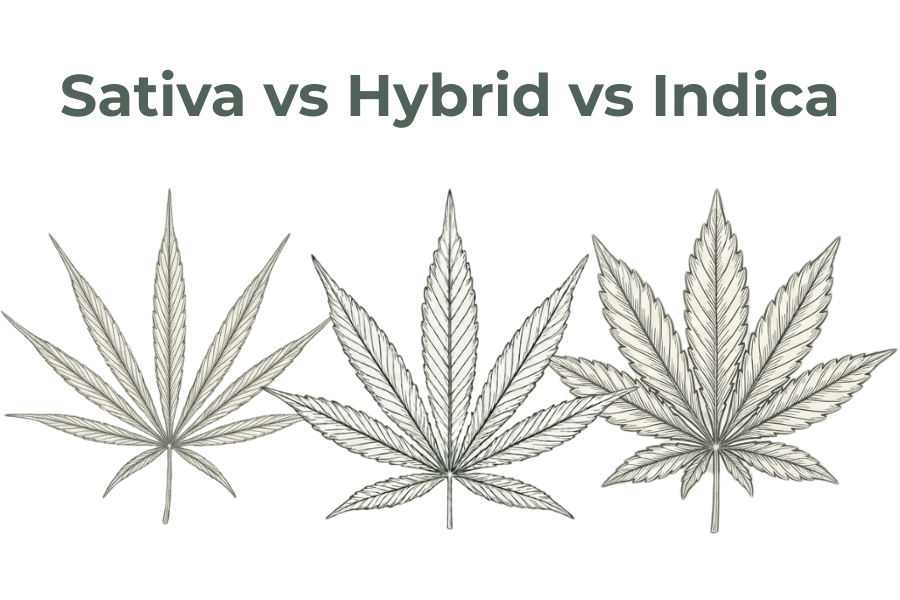
Even in a world of hybrids, the underlying genetics still express themselves. A strain bred with heavy Hindu Kush ancestry tends to grow like those original mountain plants: shorter, bushier, faster to finish, with dense, tightly-packed buds. A strain with strong equatorial sativa lineage tends to express those traits: taller, more open structure, wider spacing between nodes, longer flowering window.
Those tendencies are real and useful for planning a grow. Here’s what the labels still predict reasonably well:
Height and structure. Indica-dominant genetics stay compact, typically 2 to 4 feet. Sativa-dominant genetics stretch, often reaching 5 to 10 feet or more outdoors, and can surge dramatically in height during the first weeks of flowering. Hybrids fall somewhere between the two, depending on which lineage dominates.
Flowering time. This is the most reliable thing the labels tell you. Indica-dominant strains typically finish in 8 to 10 weeks of flowering. Sativa-dominant strains often need 10 to 16 weeks, which pushes outdoor harvest dates into October or November. For growers in northern states where frost arrives in early October, a true sativa-dominant strain may not finish before the season ends.
Bud structure and humidity performance. Indica buds are dense and heavy, which looks great at harvest but creates real vulnerability in humid conditions. Moisture doesn’t escape dense buds easily. Sativa buds are airier and more open, which reflects their equatorial origins. Those plants evolved in humid environments where airflow through the flower mattered. For outdoor growers in the humid Southeast and Mid-Atlantic (the Carolinas, Virginia, Georgia, the Gulf Coast), sativa-leaning genetics can hold up better through a wet August or a rainy stretch in September, precisely because of that structural difference.
Difficulty. Indica-dominant strains are generally more forgiving for new growers. Compact, fast, predictable. Sativa-dominant strains require more space, more patience, and more planning, especially indoors where height management becomes a real challenge.
What This Means for Your Grow
When you see “indica-dominant” or “sativa-dominant” on a seed listing, treat it as a starting point. Then look at the specific strain details: reported flowering time, expected height, and any notes on climate performance or mold resistance.
A few practical guidelines:
Short growing season or indoor tent under 6 feet: Weight your choice toward indica-dominant or compact hybrid genetics.
Long season, lower humidity, growing outdoors: Both work well. A sativa-dominant strain given a full season can be impressive.
Humid climate, growing outdoors in the Southeast or Mid-Atlantic: Sativa-leaning genetics are worth considering for their structural advantage against bud rot, even with the longer finish time.
First grow, wanting predictable results: Indica-dominant or balanced hybrid genetics give you the most consistent outcome to learn from.
The indica/sativa story turns out to be more interesting than dispensary shorthand suggests. It’s a story about plants adapting to mountain winters in Afghanistan, about equatorial strains spending unhurried seasons under a tropical sun, and about what happens when you put those two lineages together in a California grow room in 1975. The labels carry that history with them. Once you understand where they came from, they become a more useful tool.
Browse Our Seed Catalog | Use the Zone Lookup Tool
Ready to Start Growing?
Browse Our Seed Catalog | Read the Germination Guide
Frequently Asked Questions
Does indica vs. sativa affect how cannabis makes you feel?
Loosely, but not in the direct way most people assume. The experiential differences between strains have more to do with their specific cannabinoid and terpene profiles than with the indica/sativa label. Two strains both labeled indica can produce very different experiences. The labels are more reliably useful for predicting how the plant grows than for predicting how it will affect you.
Are indica and sativa actually different species?
Botanists have debated this since Lamarck introduced the distinction in 1785. Most modern taxonomists classify all cannabis as one species with multiple subspecies. The terms persist as useful shorthand for growth tendencies, even if the strict biological boundary between them does not hold up under modern genetic analysis.
What are landrace strains?
Landrace strains are cannabis populations that evolved in geographic isolation over many generations, developing traits adapted to their specific climate. Examples include Afghani (Hindu Kush mountains), Colombian Gold, Thai, and Durban Poison from South Africa. Most modern strains are hybrids of these lineages rather than pure landraces.
Which is better for outdoor growing in a short season?
Indica-dominant or compact hybrid genetics. Indica-leaning plants evolved to finish before harsh mountain winters arrived, which translates to shorter flowering times of typically 8 to 10 weeks. Sativa-dominant strains need 10 to 16 weeks of flowering, which often is not achievable before first frost in northern climates.
Why do sativa plants handle humidity better than indicas?
Sativas developed in warm, humid equatorial regions where dense, moisture-trapping buds would have been prone to rot. Their loose, airy bud structure and wider node spacing allows air to move through the flower. Indica’s dense buds evolved in the dry mountain climates of Central Asia, where that structure was not a liability.
What does hybrid mean on a seed listing?
It means the strain carries genetics from both indica and sativa lineages. Most commercial cannabis today is technically hybrid. When a listing describes a strain as indica-dominant or sativa-dominant, it is indicating which lineage exerts more influence on how that particular plant grows.
Who named cannabis indica?
Jean-Baptiste Lamarck, a French naturalist, formally named Cannabis indica in 1785 after examining specimens collected in India. Carl Linnaeus had previously classified all cannabis as Cannabis sativa in 1753, based on European hemp plants. Lamarck observed that the Indian specimens were morphologically distinct and notably more intoxicating, leading him to propose a second species.
About the Author

Matt, Co-Founder of Triangle Hemp – Matt has been growing plants commercially since 2013, starting with Endless Sun Farms before co-founding Triangle Hemp in 2017 alongside childhood friend Chase. Over more than a decade, Triangle Hemp has produced and sold over a million seeds to home growers, homesteaders, and hemp farmers across the United States. Matt and Chase manage seed selection person
We have a video series with cannabis content creator Catherine Goldberg, aka Senior Savvy Cannabis, where we guide her through her first indoor grow. If you are a new grower, you might find the videos helpful. Watch the grow videos →