

The one variable most new growers ignore until something goes wrong.
Last updated: March 2026
For growers using salt-based (bottled) nutrients, pH is the single most overlooked variable in home cannabis cultivation and causes more problems than almost anything else. If your plant is showing nutrient deficiencies despite a solid feeding schedule, pH is almost always the first place to look.
For organic growers using living soil and dry amendments, pH is far less of a daily concern. The biology in a healthy soil does most of that work for you.
This post explains what pH is, why cannabis is particular about it, what happens when it’s off, and how to test and correct it in soil and coco/hydro setups.
Quick Reference: Target pH by Medium
| Medium | Target Range | Sweet Spot |
|---|---|---|
| Soil | 6.0 to 7.0 | 6.2 to 6.8 |
| Coco coir | 5.5 to 6.5 | 5.8 to 6.2 |
| Hydroponics | 5.5 to 6.5 | 5.5 to 6.0 |
Which Type of Grower Are You?
How closely you need to manage pH depends heavily on how you’re growing. Find your setup below before reading further.
Organic soil with no bottled nutrients (living soil, compost teas, worm castings, dry amendments) pH is the least critical variable for you. The microbial life in a well-built living soil acts as a natural buffer, cycling nutrients and stabilizing the root zone without your intervention. You don’t need to obsessively test and adjust every watering. That said, it’s still worth checking your water pH occasionally and testing runoff every few weeks — problems can still develop, they just develop more slowly. Focus on the pH Ranges by Medium and Common Mistakes sections.
Salt-based (bottled) nutrients in soil pH matters consistently and you should monitor it regularly. Bottled mineral nutrients don’t carry the microbial buffering that organic inputs do, and salt buildup over time can push your root zone out of range without obvious symptoms. Test input water and runoff at least once a week. Read the full post.
Coco coir (with any nutrients) pH is critical. Coco is inert — it has no buffering capacity and what goes in is essentially what the roots experience. Plan to test every watering until you know how your setup behaves. Read the full post, paying particular attention to the coco section and how to test.
Hydroponics pH is the most important variable in your grow. Roots are in direct contact with the nutrient solution and problems show up faster than in any other medium. Daily monitoring is standard. Read everything.
Table of Contents
- What pH Actually Is
- Why Cannabis Is Particular About pH
- What Nutrient Lockout Looks Like
- pH Ranges by Medium
- How to Test pH
- How to Adjust pH
- Common pH Mistakes
- Ready to Start Growing?
- Frequently Asked Questions
What pH Actually Is
pH stands for “potential of hydrogen.” It measures how acidic or alkaline a liquid or growing medium is, on a scale from 0 to 14.
- 7.0 is neutral (pure water)
- Below 7 is acidic (vinegar, lemon juice, coffee)
- Above 7 is alkaline (baking soda, bleach, ammonia)
Here’s an analogy that makes it click: think of pH like a door that controls access to your plant’s nutrients. When pH is in the right range, the door is open and nutrients flow freely into the roots. When pH drifts too far in either direction, the door starts to close — and no matter how much food you put in front of it, the nutrients can’t get in.
One more thing worth knowing: the pH scale is logarithmic. A pH of 5.0 is not twice as acidic as 6.0. It’s ten times more acidic. Small numbers on paper mean meaningful real-world differences in your root zone.
Why Cannabis Is Particular About pH
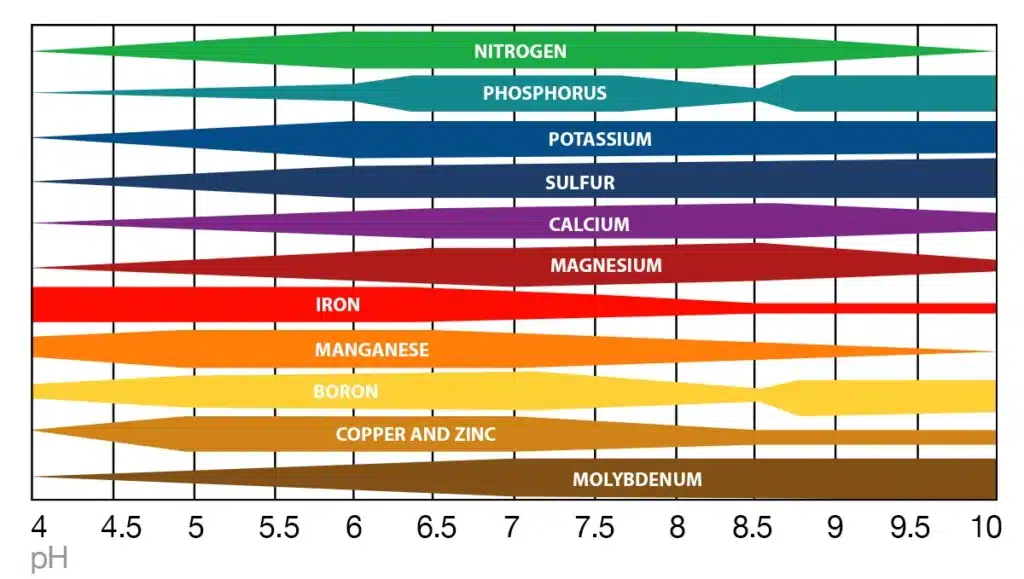
Cannabis roots don’t absorb all nutrients the same way. Each nutrient has its own preferred pH window:
- Nitrogen is most available in a slightly acidic environment
- Calcium and magnesium become less available as pH drops
- Phosphorus has a narrow window that gets squeezed at both extremes
- Iron and manganese need lower pH to be accessible
When your root zone drifts outside the right range, some of those windows close. The nutrient is in the medium (you put it there), but the roots physically cannot take it in. That’s nutrient lockout.
This is why pH problems get misdiagnosed so often. A grower sees yellowing leaves, decides the plant needs more nitrogen, adds more nitrogen, and nothing improves. The plant didn’t need more nitrogen. It had plenty. It just couldn’t access it.
The most important thing in this post: Check pH before adding nutrients. Most deficiency symptoms in well-fed plants are lockout problems, not feeding problems.
What Nutrient Lockout Looks Like
The frustrating thing about pH-driven lockout is that it mimics deficiency almost perfectly. Yellowing leaves, slow growth, pale new growth — all of these happen whether the plant is short on nutrients or just can’t absorb them.
Here’s how to read the patterns:
If pH is too high (too alkaline): Iron, manganese, and phosphorus get locked out first. You’ll see yellowing on new growth with veins staying green, pale leaves, and slow development. This is common in areas with naturally hard, alkaline tap water.
If pH is too low (too acidic): Calcium, magnesium, and potassium availability drops. Look for interveinal yellowing on older leaves, brown leaf edges, or symptoms that look like calcium deficiency.
The giveaway: Deficiency symptoms that don’t respond after a week of corrected feeding almost always point to pH. Test what’s going in and what’s coming out in the runoff. The answer is usually right there. For a full breakdown of what different yellowing patterns mean, see our guide to why cannabis leaves turn yellow.
pH Ranges by Medium
Soil
Target: 6.0 to 7.0 | Sweet spot: 6.2 to 6.8
Organic grows are more self-regulating — check water pH occasionally and test runoff every few weeks. Salt-based nutrient grows need consistent weekly monitoring of both input water and runoff. A significant gap between the two means the root zone has drifted and needs attention.
Coco Coir
Target: 5.5 to 6.5 | Sweet spot: 5.8 to 6.2
Coco has no buffering capacity. What pH goes in is close to what the roots experience, and drift happens faster than in soil. Test every watering when starting out. Once you know how your setup behaves, you can find your rhythm.
Hydroponics
Target: 5.5 to 6.5 | Sweet spot: 5.5 to 6.0
No buffer at all. Problems show up faster than in any other medium. Daily monitoring is standard. One useful technique: let pH drift slowly within the acceptable range rather than locking to a single number — different nutrients have slightly different absorption windows, so a gradual drift from 5.5 up to 6.2 and back ensures the full spectrum gets its window of availability.
How to Test pH
There are three tools available:
Digital pH meter (recommended) A pen-style meter you dip into your water or runoff. Accurate, fast, reusable. Good meters run $20 to $60. Calibrate monthly with calibration solution. Meters drift over time, and a poorly calibrated meter is worse than no meter at all.
pH test drops Liquid you add to a small water sample. It changes color to indicate pH. Inexpensive and workable for new growers, though less precise than a digital meter.
pH test strips The least accurate option. Fine for a rough check but not reliable enough to use as a primary testing method.
What to actually test:
In soil: Test your input water (after mixing nutrients, before watering) and your runoff (water that drains out the bottom of the pot). The gap between the two tells you what’s happening in the root zone. Putting water in at 6.5 and getting runoff at 5.8 means the medium has become acidic and needs attention.
In coco and hydro: Test your nutrient solution before every feeding.
How to Adjust pH
The standard tools are pH Up and pH Down, inexpensive solutions widely available at garden and grow stores.
- pH Up (typically potassium hydroxide) raises pH
- pH Down (typically phosphoric acid or citric acid) lowers pH
Four rules that matter:
1. Add nutrients first, then adjust pH. Nutrients change the pH of water. If you adjust pH before adding nutrients, you’ll need to adjust again after. Always do it in the right order.
2. Go slow. Add a few drops, stir, wait a minute, test again. The logarithmic scale means small additions move the needle more than you’d expect. Overshooting and then correcting the other way causes unnecessary stress.
3. Aim for the range, not a specific number. Getting consistently within 6.2 to 6.8 (for soil) is more useful than hitting 6.5 exactly every time. Consistency beats precision.
4. Natural alternatives work but are less stable. Citric acid or white vinegar can lower pH. Baking soda or dolomite lime can raise it. These work but are harder to dose accurately than commercial adjusters. For a first grow, the commercial options are simpler.
Common pH Mistakes
Not testing at all. The most common mistake. Many new growers assume their tap water is fine. Tap water pH varies enormously by location and can easily sit outside the optimal range.
Testing only the input, not the runoff. What you put in and what’s happening at the root zone can be very different, especially after several weeks of feeding. Runoff gives you the real picture.
Adding more nutrients when pH is the problem. If deficiency symptoms aren’t responding to corrected feeding, check pH before adding anything else. More nutrients won’t help and may make lockout worse.
Correcting too aggressively. Large, rapid pH swings stress roots. Fix big drifts gradually over several waterings rather than trying to correct everything at once.
Not calibrating the meter. A meter that reads 6.2 when the actual pH is 5.7 is actively misleading. Calibrate monthly with calibration solution.
Letting pH drift unchecked in coco or hydro. These media have little to no buffering capacity. Problems develop faster than in soil. Test more frequently than feels necessary until you know your setup well.
Ready to Start Growing?
Browse Our Seed Catalog | Read the Germination Guide | Pest and Disease Identifier
Thinking about growing but not sure what gear to buy? Check out this list of growing supplies we recommend.
Frequently Asked Questions
What is the best pH for cannabis in soil?
The target range for soil is 6.0 to 7.0, with most growers aiming to stay between 6.2 and 6.8. Soil has natural buffering capacity that helps stabilize pH, giving growers more room to work with than coco or hydro setups.
What is the best pH for cannabis in coco or hydroponics?
Both coco coir and hydroponic systems target a range of 5.5 to 6.5, with most growers working in the 5.8 to 6.2 range for coco and 5.5 to 6.0 for hydro. These media have little or no buffering capacity, so pH management requires more frequent monitoring than soil.
What is nutrient lockout?
Nutrient lockout happens when pH in the root zone falls outside the range where plant roots can absorb nutrients. The nutrients are physically present in the growing medium, but the plant cannot access them. It produces symptoms identical to nutrient deficiencies, which is why pH should always be checked before adding more nutrients.
How do I know if my pH is causing problems?
If your plant is showing deficiency symptoms despite a consistent feeding schedule, and those symptoms don’t improve after a week of corrected feeding, pH lockout is a likely cause. Test both your input water and your runoff to see what’s happening at the root zone.
Do I need an expensive pH meter?
No. A decent digital pH meter in the $20 to $40 range works well for home growing. The important thing is to calibrate it regularly with calibration solution. An uncalibrated meter is less useful than a fresh set of pH test drops.
Should I pH my water even if I’m using organic nutrients in soil?
It’s still worth monitoring, though organic grows with heavily amended soil are more self-regulating than mineral nutrient grows. The microbial activity in rich organic soil helps buffer pH in a way that reduces but doesn’t eliminate pH sensitivity. Testing runoff every few weeks is a reasonable approach for organic soil growers.
What happens if pH is too high?
High pH (above 7.0 in soil, above 6.5 in coco/hydro) causes iron, manganese, and phosphorus to become less available. You may see yellowing on new growth with green veins, pale or slow-growing plants generally. Hard tap water is a common cause of chronically high pH.
What happens if pH is too low?
Low pH (below 6.0 in soil, below 5.5 in coco/hydro) reduces the availability of calcium, magnesium, and potassium. Symptoms include interveinal yellowing on older leaves, brown or curling leaf edges, and signs that look like calcium or magnesium deficiency. Over-acidification from certain nutrient solutions or organic amendments like peat is a common cause.
About the Author

Matt, Co-Founder of Triangle Hemp – Matt has been growing plants commercially since 2013, starting with Endless Sun Farms before co-founding Triangle Hemp in 2017 alongside childhood friend Chase. Over more than a decade, Triangle Hemp has produced and sold over a million seeds to home growers, homesteaders, and hemp farmers across the United States. Matt and Chase manage seed selection person
We have a video series with cannabis content creator Catherine Goldberg, aka Senior Savvy Cannabis, where we guide her through her first indoor grow. If you are a new grower, you might find the videos helpful. Watch the grow videos →
This post contains affiliate links. As an Amazon Associate I earn from qualifying purchases.