

How a plant went from miracle cure to gas station shelf filler, and what came out the other side.
Last updated: March 2026
CBD went from obscure supplement to cultural phenomenon faster than almost any product category in American history. What followed was a gold rush, a crash, and a slow, more honest rebuilding. We were there for all of it.
Table of Contents
- Before the Boom: What CBD Actually Was
- The 2018 Farm Bill Changes Everything
- The Gold Rush
- The Hype, the Misconceptions, and the Miracle Cure Problem
- When the Market Flooded
- The Bad Actors
- The Bust
- What We Saw From Where We Were Standing
- Where Things Stand Now
Before the Boom: What CBD Actually Was
Cannabidiol has been known to scientists since the 1940s, when researchers first isolated it from the cannabis plant. For most of the following decades, it sat largely unstudied, not because it lacked promise, but because the regulatory environment in the United States made meaningful cannabis research nearly impossible. The Controlled Substances Act of 1970 placed cannabis on Schedule I alongside heroin, and that classification made federally-funded research on any part of the plant extremely difficult to pursue.
What research did exist was largely happening overseas. Israeli scientists and a small number of European researchers were accumulating evidence that CBD had real biological activity, particularly around inflammation, anxiety, and seizure disorders. But the findings were largely invisible to American consumers and most American physicians.
The compound began to enter mainstream awareness around 2013 and 2014, when a number of high-profile stories emerged about families using CBD-rich cannabis extracts to treat severe pediatric epilepsy. The cases were extraordinary and well-documented. Children were experiencing hundreds of seizures a week, whose symptoms were dramatically reduced after starting CBD oil. These stories spread widely, and for many people they were the first time they’d heard of CBD at all.
The plant people were turning to for those extracts was hemp: cannabis with less than 0.3% THC, bred for non-intoxicating uses. Under the 2014 Farm Bill, states were permitted to run hemp research pilot programs, and a small but growing number of farmers began cultivating CBD-rich hemp in places like Kentucky, Colorado, and Oregon. The products reaching consumers were largely tinctures and extracts, sold through small online retailers, at natural food stores, and through a growing network of wellness practitioners.
It was a genuine niche. The people buying CBD in 2015 and 2016 mostly knew what they were getting, why they were using it, and where it came from.
The 2018 Farm Bill Changes Everything
The Agriculture Improvement Act of 2018 did something that almost no one outside the hemp and cannabis industry fully appreciated in the moment: it removed hemp and all its derivatives, including CBD, from the federal controlled substances list.
Overnight, growing hemp went from a tightly restricted research activity to a legal commodity crop. Processing hemp into CBD extracts became a legitimate commercial enterprise at the federal level. Selling CBD products across state lines became legal. The DEA’s jurisdiction over hemp effectively ended.
The timing was significant. The wellness industry was in a period of massive growth. Consumer interest in natural and plant-based supplements was at a generational high. Social media had created the infrastructure to spread product enthusiasm at a speed and scale that had no precedent. And a compound that had been building quiet credibility for years (one with a compelling backstory, real scientific interest, and no intoxicating effects) was suddenly available to anyone with a credit card and a phone.
What came next was inevitable in retrospect.
The Gold Rush
By 2019, hemp acreage in the United States had grown from roughly 78,000 acres to over 200,000 acres. In some states, the numbers were staggering. Nevada went from a handful of registered growers to over 200 almost instantly. Arizona planted nearly 5,000 acres. Kentucky, which had been a quiet early mover in the 2014 pilot program era, became something close to ground zero for CBD hemp cultivation.
The projections being circulated at the time were intoxicating. Industry analysts were predicting the CBD market would reach $2 billion or more by 2021. Some estimates went higher. Entrepreneurs who had never grown anything were buying land and planting hemp. Investors who knew nothing about agriculture were funding processing facilities. The gap between cannabis profits and commodity crop profits had been explained to farmers across the country, and the message many heard was: this is five times the revenue per acre of soybeans. Get in now.
The retail landscape transformed just as fast. CBD appeared in gas stations, grocery stores, pharmacies, pet supply shops, yoga studios, airport kiosks, and hotel gift shops. It was in gummies, tinctures, capsules, lotions, coffee, beer, dog treats, bath bombs, and lip balm. You could find it in national chains and at farmers markets. By 2019, it was genuinely difficult to find a retail category it hadn’t entered.
The speed of that expansion was breathtaking. It was also, for many of the people who built something real in this space, deeply unsettling.
The Hype, the Misconceptions, and the Miracle Cure Problem
CBD deserves credit for what it actually does. The science supporting its use for anxiety is meaningful. Its role in seizure disorders is well-established enough that the FDA approved a pharmaceutical-grade CBD product (Epidiolex) for specific forms of pediatric epilepsy. Research on sleep, inflammation, and pain continues. For millions of people, CBD products have provided genuine relief.
The problem was not the compound. The problem was what happened when an entire industry decided that “genuine relief for many people with specific conditions” could be marketed as “cures everything.”
Within months of the 2018 Farm Bill, brands were making claims that CBD could treat cancer, dementia, Alzheimer’s disease, and dozens of other serious conditions, claims with no clinical evidence behind them, and claims that were flatly illegal under FDA rules. In 2019, the FDA sent warning letters to fifteen companies for exactly this kind of unsubstantiated marketing. The letters barely slowed the trend.
The framing that took hold in popular culture was CBD as a universal wellness molecule: something that could solve whatever ailed you, with no side effects and no questions asked. That framing did real damage. It raised consumer expectations to a level that the actual evidence couldn’t support. People bought products expecting specific therapeutic outcomes, got little or no effect (sometimes because the product was mislabeled, sometimes because their condition simply wasn’t one CBD reliably addresses), and concluded the whole thing was a scam. The bad products and the inflated claims created skepticism that landed on the good products too.
When the Market Flooded
The production boom created a supply problem that the market was never going to be able to absorb.
Researchers later estimated that meeting the entire domestic demand for CBD required less than 3,000 acres of hemp per year. In 2019, American farmers had planted more than 500,000 licensed acres. The math was brutal. CBD biomass prices collapsed. What had sold for over $4 per percentage point of CBD per pound in mid-2019 fell to around $1.30 per pound by the end of that year. Farmers who had taken on debt to plant hemp found themselves holding product they couldn’t sell at a price that covered their costs.
The regulatory situation made it worse. The FDA’s position was that CBD could not be legally added to food or sold as a dietary supplement without going through a formal approval process that didn’t yet exist. That ambiguity was enough to keep major food and beverage companies on the sidelines. Companies that might have created legitimate large-scale demand for CBD biomass stayed out of the market, waiting for regulatory clarity that moved extremely slowly.
By 2020, licensed hemp acreage had dropped to around 336,000 acres. By 2021, it had fallen to roughly 70,000. Two years of unsold biomass sat in storage while the industry tried to figure out what it had become.
The Bad Actors
It would be easy, looking back, to frame the CBD boom as a story about naive optimism. Some of it was. Plenty of people got into hemp and CBD with genuine intentions and ran headfirst into a market they didn’t understand, or into regulatory walls they couldn’t clear, or into farming conditions they hadn’t prepared for.
But a meaningful portion of what happened was something less innocent.
The combination of explosive consumer demand, almost no federal regulation, and a product that was difficult for most buyers to evaluate created conditions that bad actors took full advantage of. Studies from this period found that roughly a third of commercially available CBD products were significantly mislabeled, containing either far less CBD than the label claimed, or far more, or in some cases none at all. An FDA study of 200 products found that nearly half contained detectable THC despite claims to the contrary. Independent laboratory testing found heavy metals including lead, arsenic, and mercury in a substantial fraction of products tested. Pesticides. Residual solvents. Contaminants that had no business being in something marketed as a wellness product.
These weren’t all small operators cutting corners. Some were brands with significant marketing budgets, influencer partnerships, and national retail distribution. They built visibility and revenue on the back of claims they couldn’t support and products they hadn’t verified.
The consequence was predictable: consumers who bought products that didn’t perform, or worse, that made them question what they’d actually ingested, stopped trusting the category. That erosion of trust fell on everyone, including the brands that had been doing the work of sourcing clean genetics, testing their extracts, and being honest about what their products could and couldn’t do.
What We Saw From Where We Were Standing
We started Triangle Seeds in 2017, a year before the Farm Bill passed. Our experience in commercial cultivation went back further, to 2013, when we were growing vegetables commercially through Endless Sun Farms. We came into hemp from agriculture, not from wellness marketing. And what we were doing from the beginning was providing seeds and plants to growers: people who wanted to grow CBD hemp and build something around it.
In the years following the Farm Bill, we worked with a lot of those growers. Good people, serious people, people who had invested real time and money and energy into understanding the plant and building toward something genuine. We supplied genetics to farmers who wanted to start CBD companies, to entrepreneurs who had real visions for what honest hemp products could look like.
We also watched what happened when the gold rush arrived. We saw the price projections that made no sense. We saw people getting into the business who had no background in cultivation and no particular interest in the consumer on the other end of the transaction. We saw the market fill up with product that nobody was going to be able to sell, and we saw what that did to the people who had built carefully and were suddenly competing with a flood of biomass priced below cost.
The growth that came from the 2018 Farm Bill was genuinely exciting. We believed in what hemp could become. But the speed of what followed: the way money and ambition poured into the space before the infrastructure, the regulation, or the consumer education could keep pace. That was hard to watch. The people who got hurt most were often the ones who had started with the most genuine intentions.
Where Things Stand Now
There’s a framework that researchers and analysts use to describe how new technologies and industries develop called the Gartner Hype Cycle. It maps expectation against time, and its shape is instantly recognizable once you’ve seen it: a sharp climb to a peak of inflated expectations, a steep crash into a trough of disillusionment, and then a slow, steadier climb toward what it calls the plateau of productivity.
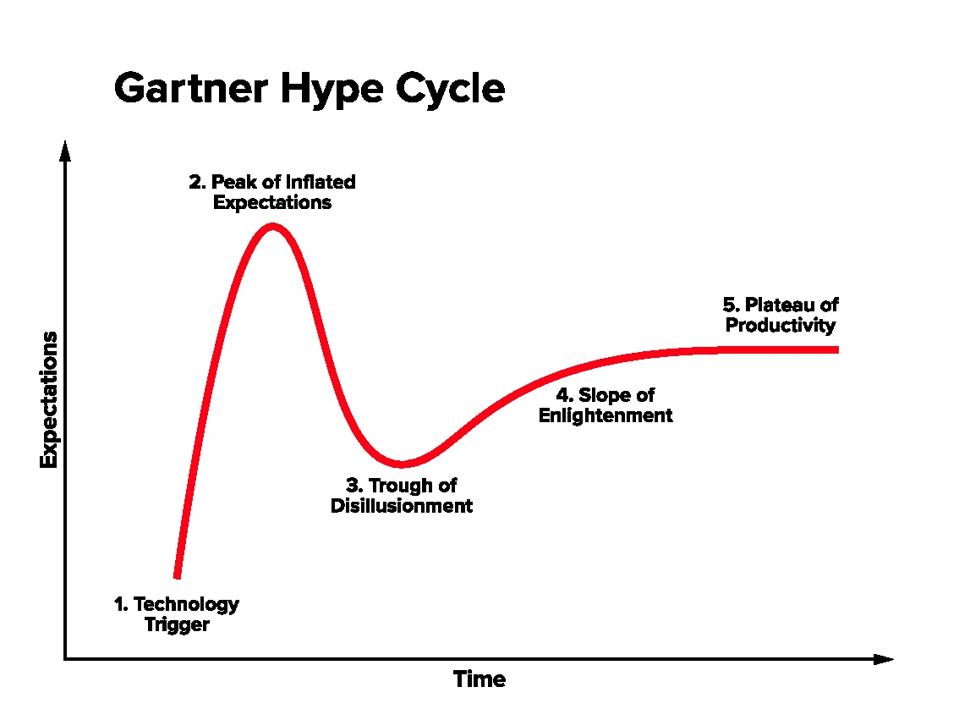
The Gartner Hype Cycle, a pattern that maps almost perfectly onto what happened to the CBD industry.
The CBD industry followed this curve almost exactly. The early epilepsy stories and the 2014 Farm Bill pilot programs were the trigger. The 2018 Farm Bill lit the fuse on the peak, and the market climbed faster and further than almost any consumer category in recent memory. The crash into the trough was equally dramatic: oversupply, regulatory paralysis, bad actors, collapsed biomass prices, and a consumer base that had been oversold and underserved.
Where things stand now, at least for the core CBD wellness market, is somewhere on the slope of enlightenment, moving toward the plateau. The broader hemp-derived cannabinoid space has its own complications — delta-8 and other intoxicating cannabinoids have been through their own secondary hype cycle, and ongoing federal legislative uncertainty keeps that corner of the industry unsettled. But for the CBD products that Triangle Seeds’s growers and customers care most about, the picture is clearer. The speculative money is gone. The brands that were built on claims rather than products are mostly gone with it. What remains is smaller, more serious, and more focused on delivering actual value to actual people.
That’s the healthiest part of the curve to occupy. And for the growers, formulators, and brands that built carefully through the chaos, it’s the part they always deserved to reach.
Browse Our CBD Seed Catalog | About Triangle Seeds
About the Author

Matt, Co-Founder of Triangle Seeds – Matt has been growing plants commercially since 2013, starting with Endless Sun Farms before co-founding Triangle Seeds in 2017 alongside childhood friend Chase. Over more than a decade, Triangle Seeds has produced and sold over a million seeds to home growers, homesteaders, and hemp farmers across the United States. Matt and Chase manage seed selection person