
A Practical Guide for Indoor and Outdoor Growers
Last updated: March 2026
The pot you choose determines how much your cannabis plant can eat, drink, and breathe. Too small and roots run out of room. Too large and the medium stays wet, roots suffocate, and you get the same struggling plant from the opposite direction. This guide covers pot sizing by plant type, nutrient approach, irrigation method, growth stage, and container type.
Quick Answers
| Situation | Recommended pot size |
|---|---|
| Autoflower, indoors, hand water | 3 to 5 gallons (plant from seed, do not transplant) |
| Autoflower, indoors, automated drip | 1 to 3 gallons |
| Autoflower, outdoors | 5 to 7 gallons |
| Photoperiod, indoors, salt-based | 1 gal seedling → 3 gal veg → 5 to 7 gal final |
| Photoperiod, indoors, organic | 5 to 7 gallon final minimum |
| Photoperiod, outdoors, salt-based | 10 to 15 gallons |
| Photoperiod, outdoors, organic | 15 to 25 gallons minimum |
| Photoperiod, full season outdoors, organic | 25 to 45+ gallons or fabric raised bed |
| Any plant, automated drip, salt-based | Can go 1 to 3 gallons (drip frequency replaces pot volume) |
| Any plant, all organic | Size up (soil biology needs volume to stay productive) |
Table of Contents
- Why Pot Size Matters
- The Overwatering Problem
- Nutrient Approach and Irrigation
- Autoflowers vs. Photoperiod
- Pot Size by Growth Stage
- When and How to Transplant
- Container Types
- Frequently Asked Questions
Why Pot Size Matters
The pot is where root health is made or broken, and root health drives everything: water uptake, nutrient absorption, plant stability, and yield.
Too small and roots fill the container and stall. The medium dries out almost immediately after watering and the plant looks stressed even when you are doing everything right. Too large and the medium holds more water than the roots can drink down. That outer wet zone never dries, oxygen cannot reach the roots, and you end up with slow, struggling plants, often mistaken for overwatering, because that is exactly what it is.
The goal is a pot sized close to where the roots actually are, with enough room to keep expanding, but not so much empty medium that it stays wet between waterings.
The Overwatering Problem
Cannabis roots depend on a wet-to-dry cycle. After watering, the medium dries down gradually, air pockets open up, and roots pull oxygen from those pockets. Break that cycle and root health deteriorates fast.
Oversized pots break the cycle by holding more water than the roots can consume. The center dries but the outer edges stay wet. Roots sit in that wet zone, oxygen-starved, while the plant above looks droopy and deficient.
How to know when to water: Lift the pot. If it feels noticeably lighter than after watering, it is time. You can also press a finger an inch or two into the medium and water when the top is dry. Never water on a fixed schedule, especially in larger containers.
Nutrient Approach and Irrigation
These two factors change the sizing math more than most guides acknowledge.
Organic grows need more volume
In a living soil system, nutrition comes from the soil itself, released by microbial activity over time. The plant pulls what it needs, but only if there is enough soil volume to support a functioning biology and an adequate nutrient reserve. A plant in a 2 gallon organic pot burns through available nutrition faster than the same plant in a 7 gallon pot. Most organic growers running full-season containers outdoors use 15 gallons minimum, many use 25 or more. Not because the roots need that much room, but because the biology does.
Salt-based grows can go smaller
In a salt-based system, nutrition comes through the water at every feeding. The medium is just a root anchor. The plant does not need to extract anything from the soil, which is why 1 gallon pots can produce serious results when the system is dialed in. Commercial greenhouse operations run very small containers with extremely frequent fertigation for exactly this reason.
Mixed approaches
Organic amendments plus liquid or synthetic feeds. You have a soil nutrient reserve but are also supplementing. Sizing can be more flexible, but going larger is safer since you have less precision control over what the biology is releasing.
Automated irrigation changes the ceiling
Hand-watering a 1 gallon pot outdoors in July means watering twice a day at peak growth. Most growers cannot keep that up without missing days, which stresses the plant.
Automated irrigation removes that constraint. A drip system running several short cycles per day keeps the root zone in a constant state of ideal moisture and oxygen availability, which is what makes very small containers viable for large yields. If you are running automated irrigation with a salt-based system, small containers are not a compromise. They are a high-performance approach.
If you are hand-watering, size to a frequency you can realistically maintain.
Autoflowers vs. Photoperiod
Autoflowers: start in the final pot
Autoflowers flower based on age, not light, and finish in roughly 70 to 90 days from seed. Every transplant causes stress, and while the plant recovers, it is not growing. With photoperiods you can extend veg to compensate. With autos you cannot. It will flip on schedule and that lost time comes directly out of yield.
Start autoflowers in their final container from seed. Do not transplant.
Final container size: 3 to 5 gallons indoors, 5 to 7 gallons outdoors. Compact varieties can finish in 2 to 3. Going beyond 7 gallons for an auto rarely improves results and just adds watering work.
Photoperiods: stage your transplants
Because you control the veg period, you can start small and move up as the plant grows, which keeps watering manageable at every stage and encourages strong root development.
Indoors, most photoperiod plants finish in 3 to 7 gallons depending on veg length. Outdoors, 10 to 30 gallons for a standard season, 30 to 100 gallons in large fabric raised beds for maximum canopy.
Pot Size by Growth Stage
Photoperiod plants only. Autoflowers go straight to their final container.
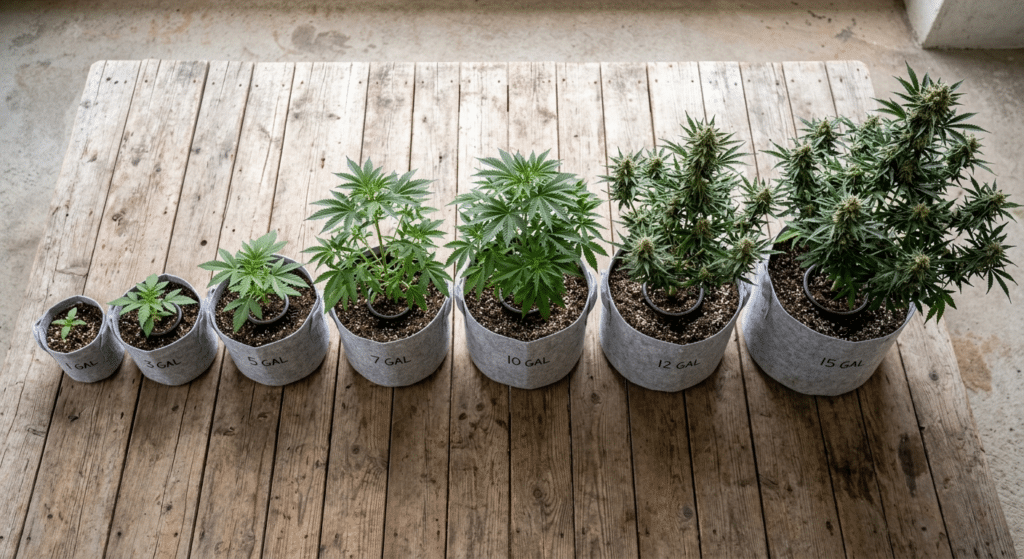
Seedling (days 1 to 14): Solo cup or 0.5 to 1 gallon. Keeps moisture easy to manage and prevents overwatering during the most vulnerable stage.
Early veg (weeks 2 to 4): Move to 1 to 3 gallons once roots reach the edges of the seedling container.
Late veg (weeks 4 to 8): Final container. 3 to 7 gallons indoors, 10 to 30 gallons outdoors. Complete this transplant before flipping to flower indoors or before the plant starts pre-flowering outdoors.
Flower: No more moving. Disrupting the root system now costs you yield.
When and How to Transplant
When: Roots coming out of the drainage holes is the clearest sign. Also watch for the medium drying out much faster than usual, slow growth despite good feeding, or rapid wilting that keeps returning.
Move the plant up before things look desperate, while there is still room for roots to push into fresh medium right away.
How:
- Water lightly the day before so the root ball holds together
- Size up gradually (1 gal to 3 gal to 5 gal, not 1 gal straight to 5 gal)
- Flip the old container, support the root ball, ease it out. Do not pull by the stem
- Set directly into a hole pre-formed in the new medium
- Water lightly around the edges to draw roots outward; do not soak immediately
- Expect one to three days of slower growth while the plant adjusts; hold off on heavy feeding
Container Types
Fabric pots
The most widely used option for good reason. Breathable walls let air reach the root zone from the sides, which stops roots from circling and triggers air pruning. When root tips hit the dry air at the fabric surface they are naturally pruned, and the plant responds by branching new roots behind the tip. Over time this creates a denser, more fibrous root system than plastic produces.
Fabric also dries faster than plastic, which keeps the wet-dry cycle tighter and gives roots better oxygen access. Trade-off is more frequent watering, especially outdoors in heat.
Common sizes: 3, 5, 7, 10 gallons for most grows. 15, 25, 45 gallons for larger outdoor plants.
Plastic pots
Cheap, durable, widely available. Hold moisture longer than fabric, which is forgiving if your watering schedule is inconsistent. Downside is roots tend to circle rather than branch. Good for seedlings and early veg; many growers use plastic through the early stages then move to fabric for the final container.
Air pots
Rigid containers with perforated, cone-covered sidewalls. Same air pruning benefit as fabric, easier to handle in some setups, and can be disassembled and reused. Dry-down rate and root health are similar to fabric. Hold their shape better than fabric outdoors, which can sag when wet. Typical sizes: 5 to 15 gallons.
Fabric raised beds
Large fabric containers that sit on the ground, from around 20 gallons to well over 200. Ideal for outdoor photoperiod plants where you want serious root volume without breaking ground. All the air pruning and drainage benefits of fabric pots, scaled up. Easier to set up and relocate than wood or masonry beds.
Plan for the watering demand. A 50 to 100 gallon bed with a full-season plant in July can drink heavily. Drip irrigation makes a lot of sense at this scale.
Thinking about growing but not sure what gear to buy? Check out this list of growing supplies we recommend.
Frequently Asked Questions
Can I transplant my autoflower?
No. Autoflowers flower on a fixed schedule and cannot recover lost time. Any transplant stress comes directly out of your yield. Plant from seed into the final container.
What happens if my pot is too small?
Roots fill the container and the plant stalls. Growth slows, the medium dries out almost immediately after watering, and you may see nutrient deficiency symptoms even on a good feeding schedule. Restricted roots cannot absorb nutrients efficiently.
What happens if my pot is too large?
The medium holds more water than the roots can drink down. The outer zone stays wet, oxygen cannot reach the roots, and conditions for root rot develop. The plant looks overwatered because it is, even if you are watering carefully.
Are fabric pots worth it over plastic?
For most grows, yes. Air pruning creates a denser root system, faster dry-down keeps the wet-dry cycle tighter, and they are reusable. The cost difference per pot is small relative to a full grow cycle.
Can I get good yields from very small pots?
Yes, with automated irrigation and a salt-based nutrient system. A 1 gallon container running several short drip cycles per day can produce impressive results because the root zone stays in an ideal state of moisture and oxygen. Without automation, small pots are hard to manage. Hand-watering? Size up.
Does nutrient approach affect pot size?
Yes significantly. Organic grows need soil volume to sustain the biology that feeds the plant. Size up. Salt-based grows deliver nutrition through the water, so the medium is just a root anchor. Smaller containers work. Mixed approaches fall in between; going larger is the safer call.
How do I know when to water?
Lift the pot. If it feels noticeably lighter than right after watering, it is time. Or push a finger an inch into the medium and water when the top is dry. Never water on a fixed schedule in larger containers.
Which Triangle Seeds strains work well in containers?
All of our genetics can be grown in containers. Our autoflower varieties are bred for exactly the kind of compact, efficient grow containers are suited for. Browse the full catalog or read our germination guide to get started.
About the Author

Matt, Co-Founder of Triangle Hemp – Matt has been growing plants commercially since 2013, starting with Endless Sun Farms before co-founding Triangle Hemp in 2017 alongside childhood friend Chase. Over more than a decade, Triangle Hemp has produced and sold over a million seeds to home growers, homesteaders, and hemp farmers across the United States. Matt and Chase manage seed selection personally, only carrying genetics Triangle Hemp has grown and tested. Learn more about Triangle Hemp.
We have a video series with cannabis content creator Catherine Goldberg, aka Senior Savvy Cannabis, where we guide her through her first indoor grow. If you are a new grower, you might find the videos helpful. Watch the grow videos →
This post contains affiliate links. As an Amazon Associate I earn from qualifying purchases.