
By Matt Spitzer | Last updated: May 2026
When you grow cannabis without doing anything to shape the plant, it naturally grows tall with one main bud at the top and smaller buds on the branches below. That works fine in a lot of situations. But many growers, especially indoors, choose to intervene by bending, tying, or pruning their plants to change how they grow.
The goal is simple: get more of the plant’s energy going to more bud sites, and make better use of the light you have. Techniques like topping, LST, scrog, and defoliation all serve that purpose in different ways. Some are low-stress and easy to learn. Others involve cutting the plant and require recovery time.
None of these techniques are required. Plenty of growers never train their plants and are happy with the results. But if you’re growing indoors and want to get more out of your setup, training is worth understanding. Use the sections below to learn about each technique and decide what makes sense for your grow.
Quick Answer
| Technique | Stress Level | Works on Autoflowers? | Best For |
|---|---|---|---|
| LST | Low | Yes | All setups, new growers |
| Defoliation | Low | Light only | Airflow, light penetration |
| Topping | High | No | More colas, fuller canopy |
| Scrog | Low | Not ideal | Indoor, single plant, 4×4+ |
High-stress techniques like topping require recovery time. Autoflowers move on a fixed schedule and rarely recover in time to benefit. Stick to LST and light defoliation for autos.
Table of Contents
- Why training matters indoors
- LST: low-stress training
- Topping
- Scrog: screen of green
- Defoliation
- How these techniques work together
- Training autoflowers
- Training outdoor plants
- FAQ
Why Training Matters Indoors
Whether and how much you train depends significantly on what light you’re running.
High-intensity single-source lights, including powerful LEDs and HPS setups, often penetrate the canopy well enough that lower bud sites still develop into quality flower without much intervention. Some growers running these setups choose not to top at all and produce excellent results. The light does enough of the work on its own.
Multi-bar LED fixtures are designed differently. Their strength is wide, even canopy coverage rather than deep penetration. Depending on the fixture and its intensity, usable light penetration typically ranges from 12 to 24 inches below the canopy, compared to a powerful single-source LED or HPS that may penetrate further. With multi-bar setups, topping becomes more important because it brings more colas up into that effective light zone. More colas at canopy level means more of the plant is sitting where the light is doing its best work.
The underlying principle is the same either way: indoor grow lights are not the sun. The sun is 93 million miles away, so light intensity doesn’t change meaningfully whether a branch is 2 feet or 6 feet tall. Indoor lights are 18–24 inches from your canopy, and intensity drops off as you move away from them. The degree to which that matters depends on your specific fixture.
Training gives you tools to work with whatever light you have. A flat, even canopy is almost always better than a Christmas tree shape indoors, but how aggressively you need to pursue that depends on your setup.
LST: Low-Stress Training

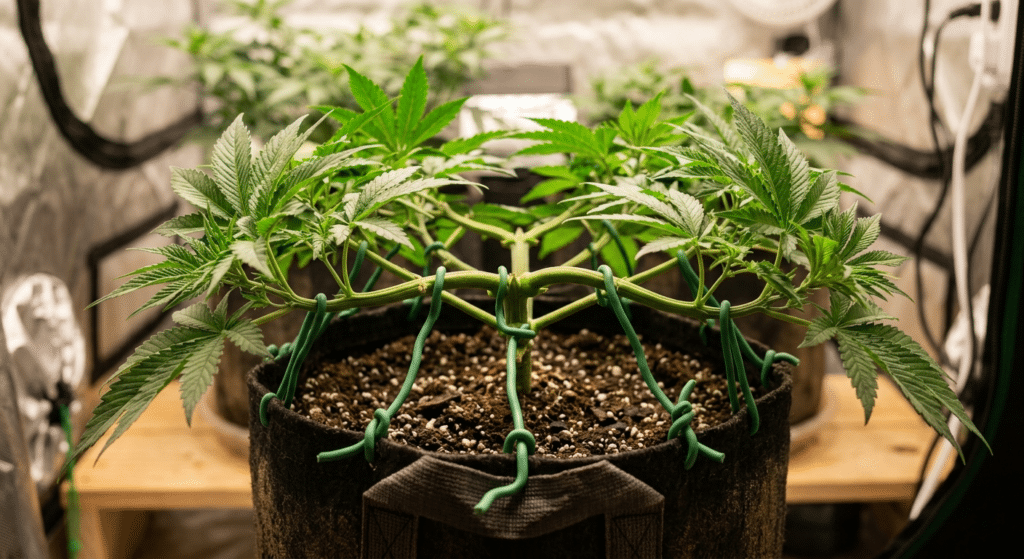
LST is the most accessible training technique and the right starting point for anyone new to training. It involves bending stems and tying them down rather than cutting anything, so the plant never stops growing and there’s no recovery period.
How it works: Cannabis plants are apically dominant, meaning they prioritize vertical growth at the top. When you bend the main stem and tie it horizontally, lower branches suddenly have access to the same light as the top. The plant treats them as new main colas and sends growth hormones to all of them equally. The result is a wider, bushier plant with multiple dominant colas instead of one.
When to start: Begin in vegetative growth when stems are still flexible, typically 2–3 weeks after germination. Stems that have hardened are more likely to crack when bent.
How to do it: Bend the main stem gently to one side and secure it to the rim of the pot with soft plant ties, garden wire, or LST clips. As new branches grow upward, bend and tie those down too. The goal is a flat, star-shaped canopy with all branches at roughly the same height. Check and adjust every few days during vegetative growth as branches continue reaching upward.
What to watch for: Stems that are bent too sharply can crack or kink. If a stem feels like it might snap, don’t force it. Bend gradually over a few sessions.
LST works with both autoflowers and photoperiods, and it pairs well with every other technique on this list.
Topping

Topping is the most common high-stress training technique. You cut off the main growth tip (the apical meristem) during vegetative growth, which forces the plant to redirect growth hormones to the two branches directly below. Instead of one main cola, you get two. Top those again and you get four. Most growers top once or twice.
When to top: Wait until the plant has at least 4–6 nodes (the points where branches meet the main stem). Topping too early stresses a plant that doesn’t yet have enough root mass or leaf surface to recover quickly.
How to do it: Use clean, sharp scissors or a blade. Cut the main stem cleanly just above the node you want to keep. Remove the growth tip entirely. New growth will emerge from the two branches below within 5–7 days.
Recovery time: Topping slows growth for several days while the plant heals and redirects its energy. Plan for a week of slower growth before things accelerate again. This recovery time is why topping doesn’t work well for autoflowers. Their vegetative window is too short to absorb the setback and still benefit.
How many times to top: Once or twice is enough for most indoor setups. Each topping creates more colas but also extends your vegetative period. Three or four tops on a single plant can work well in a 4×4 tent but requires a longer veg window.
Scrog: Screen of Green

Scrog (screen of green) uses a horizontal net or trellis placed 8–12 inches above the growing medium. As branches grow through the screen during vegetative growth, you tuck them sideways to fill it evenly. When you flip to flower, the screen is full and every branch is at the same height. The result is a dense, even canopy that uses the entire footprint of your light.
When it works best: Scrog is best suited to indoor grows with a single plant or a small number of plants in a fixed space. A 4×4 tent with one or two topped photoperiod plants and a scrog net is a reliable setup for serious indoor yields.
When to install the net: Position it before your plant reaches that height so branches naturally grow into it. Most growers start tucking when branches first poke through the screen.
How to fill it: As branches grow up through the screen, push them back down and run them horizontally through adjacent holes. The goal is to fill 70–80% of the screen before flipping to flower, with branches distributed evenly across the entire surface.
One important constraint: Once a scrog net is in place and branches are woven through it, you cannot move the plant. Make sure your watering, feeding, and inspection routine can work around a fixed plant before committing to this setup.
Scrog works best in combination with topping. Top first to create multiple main branches, then use the scrog net to spread and hold those branches at an even height.
Defoliation
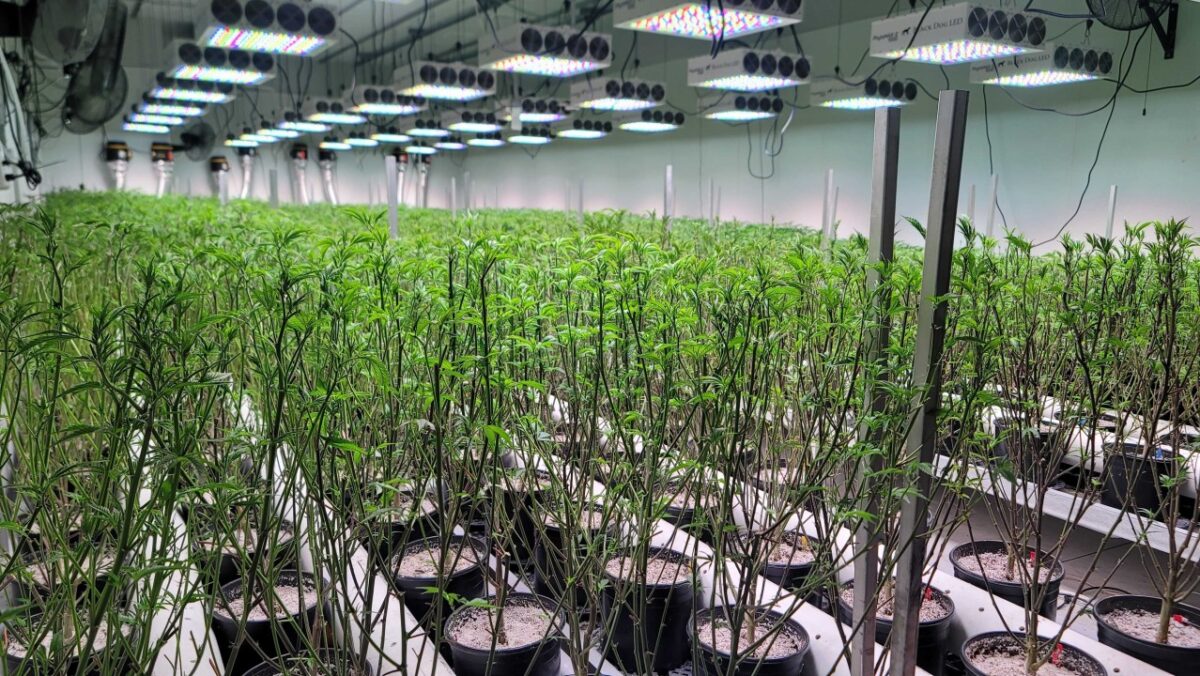
Defoliation means removing fan leaves strategically to improve airflow and light penetration. It doesn’t change the structure of the plant the way topping or LST does. Instead, it manages where the plant puts its energy by removing leaves that are blocking light to developing bud sites or creating dense, humid pockets that invite mold.
When to defoliate: Late vegetative growth and the first 2–3 weeks of flower are the most common windows. Defoliating too late in flower stresses the plant at the worst possible time.
What to remove: Focus on large fan leaves that are clearly blocking light to lower bud sites, leaves growing inward toward the center of the canopy, and any yellowing or damaged leaves. Remove them cleanly with scissors rather than tearing.
How much to remove: Less than you think. A plant that’s been aggressively defoliated will slow down significantly. The goal is to open up the canopy, not strip it. If the remaining leaves still cover most of the plant, you’ve done it right.
Outdoor use: Defoliation is the one training technique that translates well to outdoor growing. Removing dense inner growth improves airflow through a large outdoor plant, which meaningfully reduces mold risk in humid climates like the Southeast and Gulf Coast.
How These Techniques Work Together
The techniques above are most effective in combination. Here’s how we typically run them at Triangle Seeds for indoor photoperiod grows:
Vegetative growth, weeks 2–3: Begin LST. Bend the main stem and start spreading branches outward.
Vegetative growth, weeks 3–5: Top once above node 4 or 5. Continue LST on new growth as it develops.
Vegetative growth, weeks 5–8: Install the scrog net if using one. Begin tucking branches as they reach the screen. A second top is optional if the veg window allows.
Pre-flip: Defoliate lightly. Remove fan leaves blocking the canopy and any dense growth near the bottom of the plant that won’t receive meaningful light. Confirm 70–80% screen fill if using scrog.
Weeks 1–2 of flower: Final tucks in the scrog as branches stretch. One more light defoliation to open bud sites if needed.
Mid to late flower: Stop all training. The plant needs its energy focused on bud development, not recovery.
The combined result is a plant with multiple colas all sitting at the same height under your light, with good airflow through the canopy and minimal popcorn buds below.
Training Autoflowers
Autoflowers operate on a fixed timeline. They move from seed to harvest in roughly 9–11 weeks regardless of what you do, which leaves very little margin for recovery from high-stress techniques.
What works: LST and light defoliation are the only techniques we recommend for autoflowers. LST applies no stress that requires healing, so the plant keeps growing while you train it. Light defoliation in early flower can improve airflow and light penetration without meaningfully slowing development.
What to avoid: Topping and scrog are generally not worth attempting on autoflowers. Topping requires a week of recovery that eats into a timeline that’s already tight. Scrog works on a slower pace than most autos allow.
Timing: Start LST on autoflowers earlier than you would on photoperiods, around day 14–21 from germination, while stems are still very flexible. The sooner you start, the more of the vegetative window you can use to shape the plant.
For more on the differences between autoflowers and photoperiods, see our autoflower vs. feminized seeds guide.
Training Outdoor Plants
Most training techniques are primarily indoor tools, but a few translate usefully to outdoor growing.
LST outdoors: Useful for keeping tall plants below fence lines or for spreading a plant’s canopy to improve light exposure on lower branches. Less critical outdoors than indoors since sunlight reaches more of the plant naturally, but worth using if you need to manage height or shape.
Defoliation outdoors: The most practical outdoor training technique. Removing dense inner growth on large outdoor plants significantly improves airflow, which directly reduces mold risk late in the season. In humid climates like the Southeast and Gulf Coast, this is worth doing every grow.
Topping outdoors: We don’t recommend it. Outdoor plants have the space and sun to develop naturally, and the recovery time from topping costs you growth during the vegetative window. Let outdoor plants do what they do best.
Scrog outdoors: Rarely practical. The scale and mobility required for outdoor growing make fixed nets difficult to manage.
Browse our seed catalog to find photoperiod and autoflower genetics suited to your setup, or call or text us at (919) 410-6945. We’re happy to recommend strains that respond well to training.
Thinking about growing but not sure what gear to buy? Check out this list of growing supplies we recommend.
FAQ
Does training cannabis actually increase yield? Yes, for indoor growers working under a fixed light. Training creates a flat, even canopy where every bud site receives comparable light intensity. The result is more bud sites developing into dense colas rather than one dominant cola and a lot of smaller, underdeveloped growth below. The yield gain depends on how much of your canopy was previously underlit.
When should I start training cannabis plants? For photoperiods, start LST 2–3 weeks after germination and top around weeks 3–5 once the plant has 4–6 nodes. For autoflowers, start LST around day 14–21 while stems are still flexible. Never start high-stress techniques late in vegetative growth or after flowering begins.
Can you top autoflowering cannabis plants? We don’t recommend it. Topping requires a week or more of recovery time that eats into an autoflower’s already compressed vegetative window. Stick to LST and light defoliation for autoflowers.
What is the easiest cannabis training technique? LST. It requires no cutting, causes no recovery delay, and works on both autoflowers and photoperiods. Bending and tying stems down is low-risk and the results are meaningful even on a first grow.
How many times should I top my cannabis plant? Once or twice is enough for most indoor setups. Each topping creates more colas and extends the vegetative period. More than two tops works well in large tents with a long veg window, but adds time before you can flip to flower.
What is a scrog setup? Scrog (screen of green) uses a horizontal net placed 8–12 inches above the growing medium. Branches are tucked sideways through the screen during vegetative growth until it’s 70–80% full, creating an even canopy. When the plant flowers, every branch is at the same height and receives equal light. It works best for indoor photoperiod grows with one or two plants.
Does defoliation stress cannabis plants? Light defoliation done at the right time has minimal impact on plant health. Aggressive defoliation, meaning removing too many leaves too quickly, stresses the plant and slows growth. The rule of thumb is to remove less than you think you need to. Fan leaves are the plant’s solar panels. Remove the ones blocking light to bud sites, not the ones actively feeding the plant.
About the Author

I’m Matt, co-founder of Triangle Seeds. I’ve been growing commercially since 2013 and started Triangle Seeds in 2017 with my business partner Chase. If you have questions about this post or want help choosing seeds for your grow, call or text me at (919) 410-6945. Learn more about Triangle Seeds.
We have a video series with cannabis content creator Catherine Goldberg, aka Senior Savvy Cannabis, where we guide her through her first indoor grow. If you are a new grower, you might find the videos helpful. Watch the grow videos →
This post contains affiliate links. As an Amazon Associate I earn from qualifying purchases.