

Author: Matt Spitzer | Updated June 2026
Quick Answer
Caterpillars and budworms damage outdoor cannabis by boring into stems and flower sites, leaving behind frass (dark, pellet-shaped excrement) and triggering bud rot. The fastest path to control is catching them early. Pheromone traps tell you when moths are flying so you can begin treating before eggs hatch and larvae reach your plants. All products covered in this guide are OMRI Listed and approved for organic cultivation.
| Early Sign | What It Means |
|---|---|
| Frass on leaves or inside bud sites | Active feeding — check surrounding buds immediately |
| Small holes in stems with sawdust-like debris | Stalk borer entry point |
| Wilting or collapsed bud sites | Caterpillar boring through flower stem internally |
| Moths caught in pheromone traps | Egg-laying pressure is active — begin Bt applications now |
| Bud rot starting from a single interior point | Secondary infection from a caterpillar feeding wound |
Table of Contents
- Which Caterpillars Damage Outdoor Cannabis
- How to Identify Caterpillar Damage
- Using Pheromone Traps to Get Ahead of Infestations
- OMRI Listed Treatment Options
- How to Apply Bt Correctly
- Scouting Schedule for Outdoor Farms
- FAQ
Which Caterpillars Damage Outdoor Cannabis
Several moth species lay eggs on cannabis plants. The larvae are what cause the damage. The three most common in North American outdoor grows are:
Corn Earworm (Helicoverpa zea) One of the most destructive outdoor pests. The larva bores directly into developing flower sites, feeding from the inside out. Because feeding happens inside the bud, growers often find frass and rot before they find the caterpillar itself. Adults are tan or olive-colored moths with a wingspan of roughly 1.5 inches.
European Corn Borer (Ostrinia nubilalis) Larvae tunnel into stems and main stalks. Entry holes packed with frass are the primary sign. Severe infestations can cause entire branches to collapse. The adult moth is pale yellow-brown with wavy banding on the wings.
Cabbage Looper (Trichoplusia ni) A surface feeder targeting leaves and smaller flower sites. Larvae are thin and green, moving with a distinctive looping motion. Less damaging than stem borers, but a reliable indicator that moth pressure is present in your field.
All three species overwinter as pupae in surrounding soil and emerge as moths from late spring through summer. Flight activity peaks mid-summer in most growing regions, which is when egg-laying on cannabis is most aggressive. Growers who wait until they see damage have already lost the window for preventive treatment.
How to Identify Caterpillar Damage
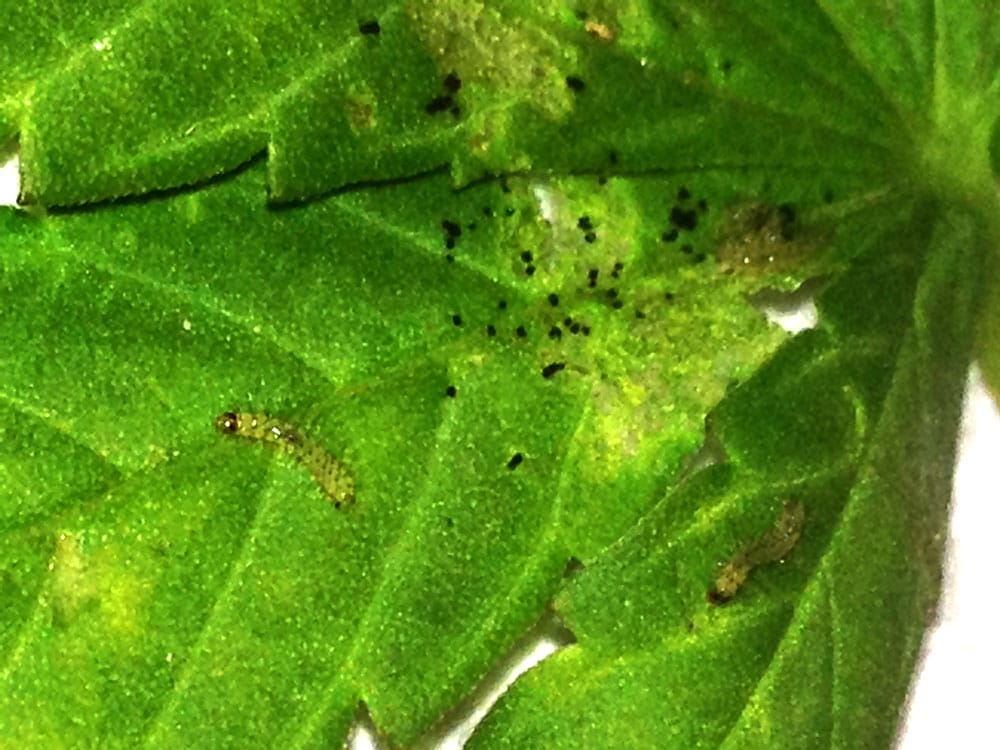
The most reliable early sign is frass. Caterpillar frass looks like dark brown or black pellets, roughly the size of coarsely ground pepper. You will find it:
- Sitting on top of leaves directly below an active feeding site
- Packed into the base of bud sites where a larva is boring inward
- Plugging the entry hole of a hollowed stem if a stalk borer is present
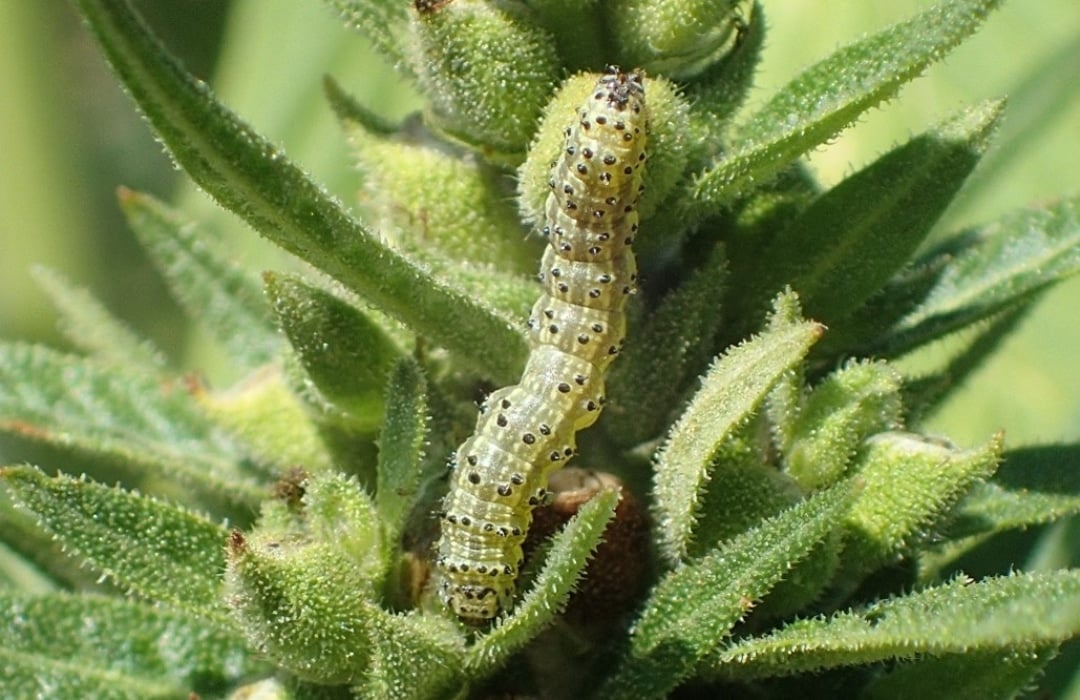
Frass inside a bud site is a red flag. The feeding wound creates a direct entry point for Botrytis (bud rot), and once rot establishes itself it spreads quickly in late-season humidity. If you find frass in a flower, open the bud carefully and look for the larva — usually cream to light green with a brown head capsule.
Other signs to watch for during scouting:
- Small circular or irregular holes in fan leaves
- Wilting bud sites that look healthy from a distance
- Unexpected bud rot that starts at a single interior point rather than spreading from the outside surface inward
- Sticky, discolored webbing at bud sites (less common, but can accompany surface-feeding caterpillars)
Using Pheromone Traps to Get Ahead of Infestations
The single biggest mistake outdoor growers make with caterpillars is treating reactively. By the time you can see damage, larvae are already inside buds, boring through stems, or large enough that Bt is far less effective. Pheromone traps solve this problem by telling you when adult moths are flying and actively laying eggs, giving you a 7 to 10 day window to begin treatment before larvae reach a damaging stage.
How pheromone traps work
Pheromone traps use a small synthetic lure that mimics the sex pheromone of a target moth species. Male moths are drawn to the lure and caught on a sticky insert inside the trap. You count the catch once or twice per week. A spike in catches tells you a flight event is active in your area.
Common species-specific lures available for cannabis growers:
- Corn Earworm (Helicoverpa zea) lure
- European Corn Borer (Ostrinia nubilalis) lure
- Cabbage Looper (Trichoplusia ni) lure
Each lure is species-specific, so a corn earworm lure will not attract European corn borers. If your region has multiple species of concern, run one trap per species.
Placement and monitoring
Place traps at crop canopy height, roughly one trap per two to five acres depending on field size and local pest pressure. Check traps twice per week during the core flight season (typically July through September in most of the US). Record catch numbers in a simple log — a spike of more than five to ten moths per trap per week is generally considered an action threshold worth responding to with a Bt application.
Replace lures every three to four weeks or per manufacturer instructions, as potency degrades over time. Lures and wing-style traps are widely available through agricultural supply companies.
Why traps are worth the investment for field-scale grows
At commercial scale, a single wave of undetected caterpillar pressure can mean significant bud rot losses across a field in a matter of days. Traps give you eyes on moth populations without walking every row daily. The cost of a few traps and lures is minimal compared to the cost of a reactive spray campaign or lost harvest weight.
OMRI Listed Treatment Options
All treatment options below are OMRI Listed, meaning they have been reviewed and approved for use in certified organic production. Always verify the current OMRI status of any product on the OMRI Products List before purchasing, as listing status can change.
Important — flowering stage restrictions: Three commonly used OMRI Listed products (spinosad, pyrethrin, and kaolin clay) should not be applied once flowering begins. Bacillus thuringiensis (Bt) is the only recommended treatment once plants are in flower. Details are in each section below.
Bacillus thuringiensis var. kurstaki (Btk)
Btk is the most effective and widely used OMRI Listed treatment for caterpillars on outdoor cannabis. It is a naturally occurring soil bacterium that produces proteins toxic to caterpillar larvae when ingested. It has no effect on beneficial insects, mammals, birds, or fish, and leaves no residue concerns for organic production.
Btk works only on larvae that ingest it while feeding on treated plant tissue. It does not affect eggs or adult moths. This is why trap monitoring matters — you want to apply Btk shortly after a moth flight event, when eggs are hatching and young larvae are actively feeding on the surface before they bore inside stems or buds.
Btk is safe and recommended through all stages of growth, including mid flowering. It breaks down quickly and leaves no meaningful residue. It is the right tool to reach for any time caterpillar pressure shows up during flower.
Spinosad — Vegetative Stage Only
Spinosad is derived from a naturally occurring soil actinomycete (Saccharopolyspora spinosa) and is OMRI Listed. It works through contact and ingestion and has some activity on larger larvae that Bt may miss.
Do not use spinosad once flowering begins. Spraying any liquid onto dense flower sites increases Botrytis risk, and spinosad applied during mid-to-late flower can affect bud aroma and flavor. Spinosad also carries a toxicity concern for bees when wet, so vegetative stage applications should always be made in the evening after pollinators have stopped foraging. If you have caterpillar pressure in flower, use Bt.
Kaolin Clay — Vegetative Stage Only
OMRI Listed kaolin clay creates a physical barrier on plant surfaces that disrupts egg-laying by adult moths and makes plant surfaces inhospitable for newly hatched larvae. It is a useful preventive tool before flowering begins.
Do not apply kaolin clay once flowering begins. Unlike fruits and vegetables that can be washed before consumption, cannabis flower is dried and consumed directly. Kaolin clay coats bud surfaces and embeds in resin glands where it cannot be adequately removed. Use it during vegetative growth as a preventive barrier alongside your Bt program, and stop before flower sites develop.
Pyrethrin — Vegetative Stage Only
Pyrethrin is OMRI Listed and approved for organic agriculture on many crops, but it is not appropriate for cannabis during flowering. Pyrethrin residues on cannabis flower are difficult to detect and quantify due to chemical similarities between pyrethrins and cannabinoids, and inhalation is a more direct exposure route than ingestion of residues on food crops. If pyrethrin is used during vegetative growth, allow enough time before flowering begins for full breakdown.
How to Apply Bt Correctly
Timing, coverage, and UV degradation are the three things that determine whether a Bt application works.
Timing Apply within 24 to 48 hours of identifying a moth flight event from your trap monitoring. Young larvae (first and second instar) are far more susceptible to Bt than older, larger larvae. If you wait until larvae are visible inside buds, Bt efficacy drops significantly because caterpillars are no longer surface-feeding on treated tissue.
Coverage Caterpillars feed on bud sites and the interior of flower clusters. Application needs to reach these areas, not just the tops of fan leaves. Use enough spray volume to achieve thorough canopy penetration. A high-pressure backpack sprayer or a boom system set up for dense canopy coverage works better than a light pass with a handheld sprayer.
UV Degradation Bt degrades in UV light within one to three days of application. This means repeat applications are necessary throughout a moth flight event. Apply every five to seven days during periods of active trap catches, and reapply after any significant rain event that washes product off plant surfaces.
pH Bt is most stable and effective when mixed in water with a pH between 6.0 and 7.0. If your water supply runs alkaline, adjust with a small amount of citric acid before mixing. This detail is often overlooked and directly affects how long the Bt protein remains active after mixing.
Mixing Mix Bt fresh before each application. Pre-mixed solution loses potency quickly. Follow label rates — more is not better with Bt, and underdosing reduces efficacy. Use the rate indicated for caterpillar control, which is often at the higher end of the label range.
Scouting Schedule for Outdoor Farms
| Timing | Action |
|---|---|
| Early June | Deploy pheromone traps at canopy height — one per 2 to 5 acres |
| June through September | Check traps twice per week, log catch numbers |
| After trap spike (5+ moths/trap/week) | Begin Bt applications within 48 hours |
| Every 5 to 7 days during active flight | Reapply Bt |
| Weekly during vegetative growth | Check stems and canopy for frass at minimum 10 plants per 1,000 sq ft |
| After rain events | Reapply Bt regardless of scheduled interval |
| Once flowering begins | Switch to Bt only — stop spinosad, kaolin clay, and pyrethrin |
| Late season (flowering) | Increase scouting frequency to twice per week — caterpillar damage plus bud rot risk is highest at this stage |
Scouting should focus on areas of the field where you have caught the most moths on your traps, low-lying areas with reduced airflow, and any spots where neighboring crops (corn, tomatoes, brassicas) may be adjacent. These crops can act as reservoir populations for corn earworm and cabbage looper.
Thinking about growing but not sure what gear to buy? Check out this list of growing supplies we recommend.
FAQ
What is the white or tan caterpillar I found inside my cannabis bud? That is most likely a corn earworm larva (Helicoverpa zea). They are cream to pale green when young, becoming more tan or brown as they mature. Finding one inside a bud means the larva bored in from the outside, likely through the top of the flower. Check the surrounding area for frass and inspect neighboring bud sites.
Can I use Bt during late flowering? Yes and No. Bt is the recommended treatment through all stages of growth including late flower but there is little research to say for sure that it should be used right before harvest. We tend to err on the side of caution and stop at least a week or two before harvest. It does break down quickly, has no meaningful residue concerns, and does not carry the contaminant risks associated with spinosad, kaolin clay, or pyrethrin at that stage. Always confirm with your certifier if you are operating a certified organic program.
Can I use spinosad during flowering? No. Spinosad should be used during vegetative growth only. Once flowering begins, spraying any liquid onto dense bud sites increases Botrytis risk, and spinosad can affect bud aroma and flavor when applied during flower. If you have caterpillar pressure during flowering, use Bt.
Can I use kaolin clay during flowering? No. Kaolin clay coats bud surfaces and embeds in resin glands. Unlike vegetables that can be washed before eating, cannabis flower is consumed directly. Kaolin clay is a useful preventive tool during vegetative growth but should not be applied once flower sites develop.
Should I use pyrethrin on flowering cannabis? No. Pyrethrin is not recommended once flowering begins. Pyrethrin residues on flower are difficult to detect due to chemical similarities with cannabinoids, and inhalation presents a more direct exposure route than ingestion of residues on food crops. Use pyrethrin during vegetative growth only, if at all.
How many pheromone traps do I need for my field? A common starting point is one trap per two to five acres. Larger fields or fields with historically high pest pressure benefit from tighter spacing. If you are growing multiple varieties with different flowering windows, place traps near each variety block since flight timing and plant attractiveness can vary by cultivar.
Why are pheromone traps catching moths but I do not see any caterpillar damage yet? That is the goal. Traps catching moths means adults are flying and laying eggs. Damage will come in seven to ten days when those eggs hatch. Begin Bt applications now. If you wait until you see damage, you are already behind.
Can I still use buds that had caterpillars in them? It depends on whether bud rot has developed at the feeding site. A bud with a caterpillar but no rot can often be salvaged by removing the damaged portion well beyond the affected tissue. Any bud with visible gray mold, slime, or discoloration beyond the immediate feeding wound should be removed and discarded. Do not try to dry and cure a bud with active rot — it will spread to surrounding material.
Ready to Grow?
If you are looking for genetics proven to perform outdoors, browse our full seed catalog at Triangle Seeds.
Author Bio

Matt, Co-Founder of Triangle Seeds — Matt has been growing commercially since 2013 alongside co-founder Chase. Over a decade, Triangle Seeds has sold over a million seeds to home growers and hemp farmers across the US. We ship nationwide. Call/text (919) 410-6945. Learn more
We have a video series with cannabis content creator Catherine Goldberg, aka Senior Savvy Cannabis, where we guide her through her first indoor grow. If you are a new grower, you might find the videos helpful. Watch the grow videos →
This post contains affiliate links. As an Amazon Associate I earn from qualifying purchases.