
Author: Matt Spitzer | Updated July 2026
Quick Answer
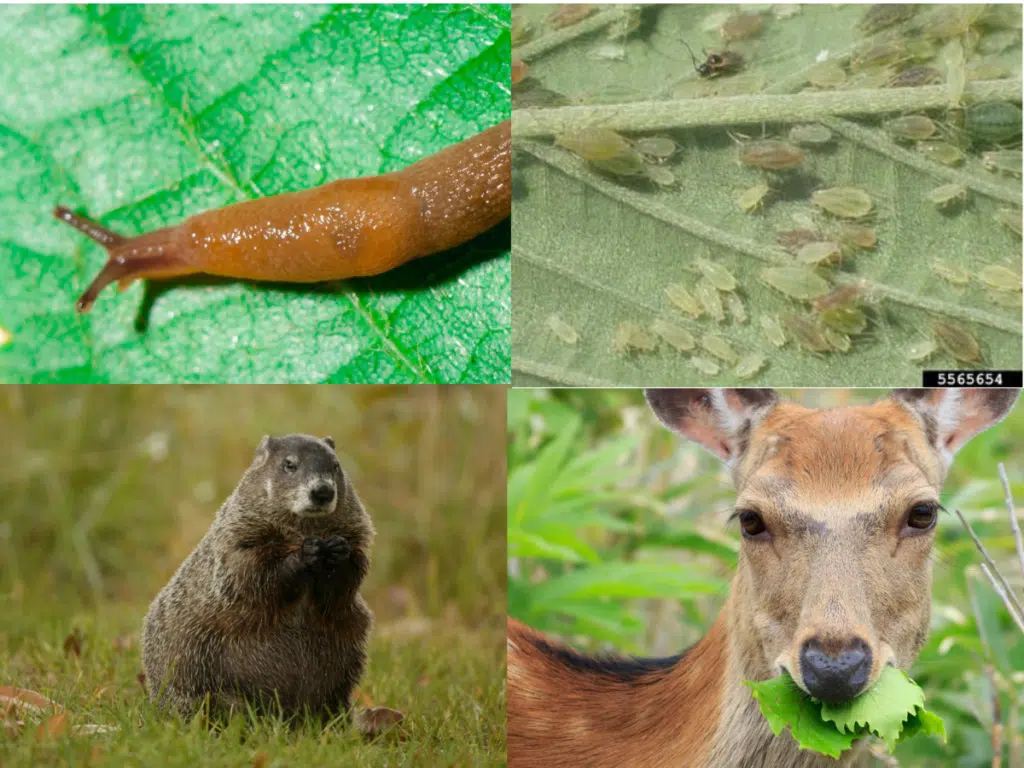
Cannabis plants are a target for a wide range of pests, from microscopic mites to full-grown deer. Insects and mites are the most common threat and are covered in detail on our individual pest pages, which you can identify using our What Pest Is This? tool. Slugs, snails, grasshoppers, and a long list of mammals from rabbits to javelinas cause a different kind of damage, usually chewed stems, missing seedlings, or flattened plants, and each requires its own prevention approach covered below.
| Group | Common Offenders | Typical Damage |
|---|---|---|
| Sap-sucking and foliage insects | Thrips, aphids, spider mites, whiteflies, russet mites | Stippling, speckling, curled or bronzed leaves |
| Boring and chewing insects | Caterpillars, budworms, grasshoppers, crickets | Holes in leaves, tunnels in stems and buds |
| Mollusks | Slugs, snails | Ragged holes in leaves, slime trails |
| Small mammals | Rabbits, squirrels, voles, cats | Clipped seedlings, gnawed stems, dug-up roots |
| Large mammals | Deer, groundhogs, javelinas | Browsed tops, flattened plants, uprooted seedlings |
| Birds | Pigeons, sparrows, finches | Picked-at seed heads, damaged seed crops |
Table of Contents
- Sap-Sucking and Foliage-Feeding Insects
- Boring and Chewing Insects: Caterpillars, Budworms, Grasshoppers, and Crickets
- Slugs and Snails: Why Are My Cannabis Seedlings Disappearing Overnight?
- Small Mammals: Rabbits, Squirrels, Voles, and Cats
- Large Mammals: Do Deer, Groundhogs, and Javelinas Eat Cannabis?
- Birds: Do Birds Eat Cannabis Seeds?
- Building a Perimeter Defense Plan
- FAQ
Sap-Sucking and Foliage-Feeding Insects
This group covers the insects and mites most growers encounter first, and the ones our site has the deepest resources on. Rather than repeat detailed identification and treatment steps here, use our What Pest Is This? tool to answer a few quick questions and get routed to the right page.
Thrips are tiny, tubular insects that leave silver streaks and scraped-looking patches on leaves. Read more on our thrips page.
Aphids cluster on tender new growth and leaf undersides, leaving behind sticky honeydew. Read more on our aphids page.
Root aphids feed below the soil line, causing plants to look hungry and stalled no matter how well they are fed. Read more on our root aphids page.
Spider mites cause fine stippling that worsens over time, eventually accompanied by webbing in heavy infestations. Read more on our spider mites page.
Russet and broad mites twist and harden new growth in a way that is often mistaken for a nutrient problem. Read more on our russet and broad mites page.
Whiteflies lift off the plant in a small cloud when disturbed and leave the same sticky honeydew residue as aphids. Read more on our whiteflies page.
Fungus gnats are small flies whose larvae damage roots in overly wet growing media. Read more on our fungus gnats page.
If you are unsure which of these you are looking at, the What Pest Is This? tool is the fastest way to narrow it down. Answer a few questions about symptoms, location on the plant, and whether you are seeing insects move, and it routes you to the matching page.
Boring and Chewing Insects: Caterpillars, Budworms, Grasshoppers, and Crickets
Caterpillars and budworms are the most damaging chewing insects for outdoor cannabis, boring directly into stems and flower sites. We cover identification, pheromone trap monitoring, and OMRI Listed treatment in detail on our caterpillars and budworms page.
Grasshoppers and crickets are common outdoor pests that can defoliate a plant quickly, especially during dry years when other food sources are scarce. Unlike the insects above, we do not yet have a dedicated page for this group, so here is what to do about them.
Grasshoppers and crickets chew irregular holes through leaf tissue and, in heavy pressure years, can strip a young plant down to bare stems within days. They are most damaging to seedlings and young vegetative plants that have not yet built enough leaf mass to absorb the loss.
Prevention and treatment:
- Row covers or fine mesh netting over young plants during the first several weeks outdoors physically blocks access and is the most reliable defense during early vegetative growth.
- Kaolin clay applied during vegetative growth acts as a feeding deterrent and is OMRI Listed for organic production. Stop applications before flowering begins, as it is not appropriate for cannabis flower.
- Nosema locustae, a naturally occurring protozoan sold as an OMRI Listed grasshopper bait, is effective when applied early in the season before grasshopper populations peak. It works slowly, over several weeks, so it is a season-long strategy rather than a rescue treatment.
- Keeping the area immediately around your plants mowed and free of tall grass removes the habitat grasshoppers prefer and reduces pressure on the crop itself.
- For isolated outbreaks, handpicking in the early morning while grasshoppers are still sluggish from cooler overnight temperatures can meaningfully reduce numbers in a small garden.
Slugs and Snails: Why Are My Cannabis Seedlings Disappearing Overnight?
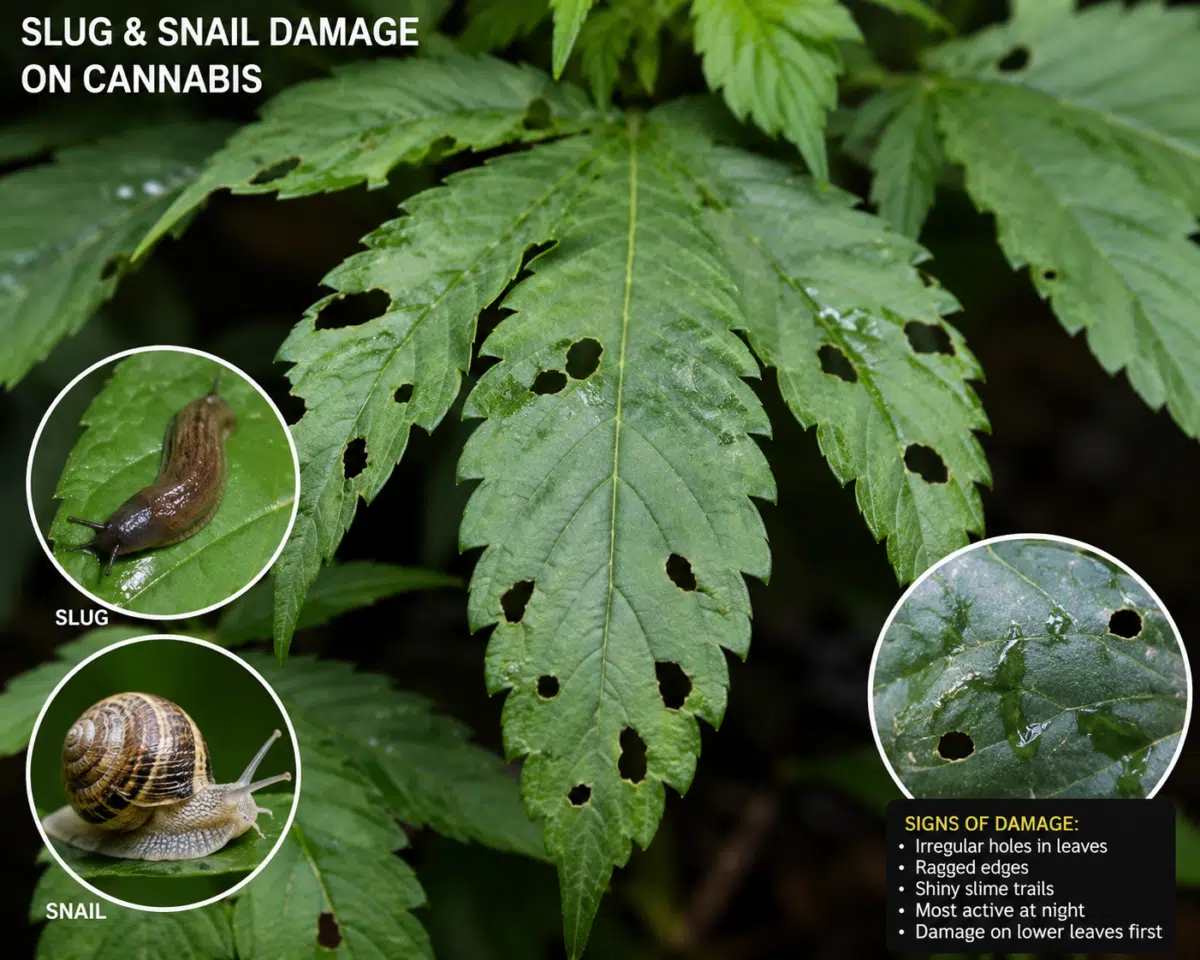
Slugs and snails are mollusks, not insects, and they cause a distinct pattern of damage: large, ragged holes in leaves, often with visible slime trails nearby, especially on lower leaves close to the soil. They are most active at night and during cool, damp conditions, and are a bigger problem for young, tender seedlings than for established plants with thicker foliage.
Prevention and treatment:
- Copper tape or copper mesh placed around the base of containers or raised beds creates a barrier that slugs and snails avoid crossing, since contact with copper produces a mild electrical reaction that deters them.
- Diatomaceous earth applied in a ring around the base of plants works as a physical barrier, but loses effectiveness once wet and needs to be reapplied after rain or irrigation.
- Iron phosphate slug bait is OMRI Listed and considered one of the safer control options for organic gardens. It is far less toxic to pets and wildlife than older metaldehyde-based baits.
- Removing mulch, boards, or other damp hiding spots near the base of plants reduces daytime shelter for slugs and snails, which prefer to stay hidden until nightfall.
- Handpicking at night with a flashlight is effective in small gardens and gives you a direct read on how much pressure you actually have.
- Beer traps are a simple, low-cost option many outdoor growers already use. Bury a cup or shallow container so the rim sits level with the soil, fill it partway with cheap beer, and slugs drawn in by the scent fall in and drown. Each trap covers roughly a 3 foot radius, so a few traps spaced through the affected area works better than one trap for the whole bed. Refresh the beer every few days, since it loses effectiveness as it evaporates or gets diluted by rain.
Small Mammals: Rabbits, Squirrels, Voles, and Cats
Rabbits clip young stems and leaves cleanly at an angle, a signature difference from the ragged tears left by insects or deer. They are most damaging to seedlings and young clones, which can be cut down to nothing in a single night.
Squirrels dig up newly planted seedlings and seeds, sometimes out of curiosity rather than hunger, and can also gnaw on stems and clip branch tips.
Voles and gophers work below ground, damaging root systems and sometimes pulling small plants entirely underground. Their presence is often first noticed through raised tunnel ridges in the soil rather than visible damage to the plant itself.
Cats are an unusual but real problem several of our customers have reported. Unlike most plant-chewing behavior in cats, this is not simple curiosity. Cannabis plants produce compounds that trigger a similar attraction response in cats to catnip, and cats will actively seek out and target young cannabis growth for this reason. A cat drawn to a seedling will often bite off the entire growing tip in one motion, which can set back or kill a young plant that has not yet developed a second set of true leaves.
Prevention and treatment:
- A physical barrier is the most reliable defense against all of the animals in this group. Chicken wire cages or hardware cloth cylinders around individual seedlings, buried a few inches into the soil, block rabbits, squirrels, and cats while the plant is at its most vulnerable stage.
- For voles and gophers, wire mesh baskets lining the planting hole prevent underground access to the root ball without requiring a full-bed barrier.
- Raised beds with hardware cloth stapled to the underside of the frame keep burrowing animals out from below while still allowing normal drainage.
- Motion-activated sprinklers are effective against rabbits, squirrels, and cats, since the sudden movement and water startle the animal without causing harm.
- For cats specifically, a simple cover such as an inverted berry basket or a small cloche placed over each seedling for the first two to three weeks removes easy access to the growing tip during the window when the damage matters most. Because cats are drawn to the plant itself rather than just investigating it, a physical barrier works far more reliably than scent-based repellents alone. Bitter apple spray or diluted cayenne pepper spray on nearby foliage can add a secondary deterrent layer once the plant is past the seedling stage.
- Predator scent granules (fox or coyote urine) can provide temporary deterrence for rabbits and squirrels, though effectiveness fades with rain and needs reapplication.
Large Mammals: Do Deer, Groundhogs, and Javelinas Eat Cannabis?
Deer browse the tops of plants, often taking several inches off the main cola and upper branches in a single visit. Because deer travel established paths and return to food sources they find reliable, an unprotected patch that gets discovered once is likely to be revisited.
Groundhogs (woodchucks) are burrowing animals that both dig beneath plants and chew through stems at ground level. They are strong enough to knock over young plants and persistent enough to return to the same garden repeatedly once they find it.
Javelinas are less commonly discussed but a real concern for growers in the Southwest. They root through soil in search of food and can flatten or uproot entire rows of plants in a single pass, causing damage that is closer to what you would expect from livestock than from a typical garden pest.
Prevention and treatment:
- A fence at least 7 to 8 feet tall is generally required to reliably keep deer out, since they are capable of clearing shorter fences without much difficulty. Electric fencing with a single or double-strand wire baited with peanut butter is a lower-cost alternative that trains deer to avoid the area after one or two contacts.
- For groundhogs, fencing needs to extend at least a foot below ground level and angle outward, since a groundhog that cannot go over a fence will typically try to go under it.
- Javelina-resistant fencing needs to be sturdy at ground level, since javelinas push and root rather than jump. Welded wire fencing anchored tightly to the ground is more effective than lighter mesh that can be pushed through.
- Motion-activated lights and sprinklers add a layer of deterrence for all three animals, though they are best used alongside a physical barrier rather than as a standalone solution for larger mammals.
- Removing brush piles, wood stacks, and other cover near your growing area makes the site less appealing to groundhogs and javelinas looking for both food and shelter in the same location.
Birds: Do Birds Eat Cannabis Seeds?
Pigeons, sparrows, and finches are the most common birds that cause problems for outdoor cannabis growers. Birds cause less overall damage than insects or mammals, but they target something specific that other pests generally do not: the seeds themselves. Growers producing seed, whether intentionally through pollination or dealing with an accidentally pollinated crop, are the most likely to notice bird damage.
Birds also occasionally peck at ripening buds, particularly on plants growing near open fields or areas without much tree cover, though this is less common than seed predation. Damage typically shows up as picked-apart seed heads, scattered plant debris beneath the canopy, and birds perching directly on branches, which is usually visible if you are scouting regularly.
Prevention and treatment:
- Bird netting draped over plants during seed development is the most reliable defense. Anchor it securely at the base, since birds will find and exploit any gap.
- Reflective deterrents such as bird tape, old CDs, or foil strips hung near the canopy create movement and light flashes that birds generally avoid. Effectiveness fades over time as birds acclimate, so combine with netting for anything valuable.
- Bird repellent gel applied to nearby perching structures (fence posts, stakes) makes those surfaces uncomfortable to land on without affecting the plant itself.
- For small-scale seed production, individual mesh bags placed over specific seed-bearing branches protect the highest-value material without covering the entire plant.
Building a Perimeter Defense Plan
The pests and animals covered in this guide range enormously in size, but the defense strategy for most of them follows a similar logic: protect the most vulnerable stage of the plant first, since seedlings and young clones are disproportionately targeted by nearly everything on this list, from cats to grasshoppers to rabbits.
A practical outdoor setup layers defenses rather than relying on one method:
- Individual seedling protection (cages, cloches, or mesh) for the first several weeks outdoors
- A mid-height barrier (chicken wire or hardware cloth fencing) to stop rabbits, squirrels, and groundhogs
- A tall perimeter fence if deer, javelina, or other large mammals are active in your area
- Regular scouting for insect and mollusk pressure using the What Pest Is This? tool once plants are established
Most outdoor growers do not need every layer described here. Match your defenses to what is actually active in your region rather than building for every possibility on this list.
FAQ
What are the most common animals and pests that eat cannabis plants? The most common threats are sap-sucking insects (thrips, aphids, spider mites, whiteflies), boring insects (caterpillars and budworms), slugs and snails, and mammals including rabbits, squirrels, deer, and groundhogs. Which ones cause the most damage in your garden depends heavily on your region. Coastal and humid climates see more mollusk and fungal pressure, while rural areas near woodland or desert habitat see more mammal pressure from deer, javelinas, or groundhogs.
What is eating my cannabis seedlings overnight? The most likely culprits for overnight seedling loss are slugs and snails, rabbits, or cats. Slugs and snails leave slime trails and ragged leaf damage. Rabbits clip stems cleanly at an angle. Cats tend to bite off just the growing tip out of curiosity rather than eating the whole plant. Checking for slime trails or a clean angled cut versus a bitten tip will usually tell you which one you are dealing with.
How do I know if damage is from insects or a larger animal? Insect damage is typically small-scale and localized, such as stippling, speckling, or small holes concentrated on specific leaves. Animal damage tends to be larger in scale, such as an entire branch tip missing, a plant flattened, or seedlings pulled from the ground. If you are seeing whole leaves or stems disappear rather than surface damage, you are likely dealing with a mammal rather than an insect.
Do deer actually eat cannabis? Yes. Deer will browse cannabis, particularly younger plants, though preference varies by region and by what other food sources are available nearby. Once a deer finds a reliable food source it tends to return, which is why fencing tends to be more effective long-term than repellent sprays alone.
Are javelinas really a problem for cannabis growers? For growers in javelina range, primarily the Southwest, yes. Javelinas root through soil looking for food and can cause significant physical damage to a planting by rooting and trampling rather than selective feeding. Sturdy, ground-anchored fencing is the most reliable defense.
Is it safe to use slug and snail bait around pets? Iron phosphate baits, which are OMRI Listed, are considered significantly safer around pets and wildlife than older metaldehyde-based baits. Always follow label directions and keep any bait product out of direct reach of curious pets regardless of formulation.
Why do cats bite the tops off my seedlings? Cats are genuinely attracted to cannabis, similar to their response to catnip, rather than simply investigating the plant out of curiosity. This is why cats often target cannabis seedlings specifically rather than other plants in the same garden. A physical cover over each seedling for the first few weeks removes the opportunity and is more reliable than scent deterrents alone, since the plant itself is what draws the cat in.
Do birds eat cannabis seeds? Yes, birds are one of the few pests that specifically target cannabis seeds rather than the plant’s leaves or stems. Pigeons, sparrows, and finches will pick apart seed heads once seeds begin to mature. Bird netting during seed development is the most reliable way to protect a seed crop.
Do deer eat cannabis plants? Yes. Deer will browse cannabis, particularly younger plants and fresh growth entering flower, though how much of a problem this becomes depends heavily on your region and what other food sources are nearby. Once a deer finds a reliable food source it tends to return to the same spot, which is why a physical fence tends to outperform repellent sprays over a full season.
Will javelinas eat my cannabis plants? Javelinas are omnivorous and known to root through gardens broadly, causing damage to a wide range of plants including cannabis, particularly by digging and rooting near the base rather than selectively browsing the foliage. Sturdy fencing anchored tightly at ground level is the most effective defense, since javelinas push and root rather than jump.
Looking for Genetics That Perform Outdoors?
Browse our full seed catalog at Triangle Seeds. We ship nationwide and are available by call or text at (919) 410-6945 if you have questions about pest and wildlife pressure in your specific region.
Author Bio

Matt, Co-Founder of Triangle Seeds — Matt has been growing commercially since 2013 alongside co-founder Chase. Over a decade, Triangle Seeds has sold over a million seeds to home growers and hemp farmers across the US. We ship nationwide. Call/text (919) 410-6945. Learn more
We have a video series with cannabis content creator Catherine Goldberg, aka Senior Savvy Cannabis, where we guide her through her first indoor grow. If you are a new grower, you might find the videos helpful. Watch the grow videos →