

Author: Matt Spitzer | Updated September 2026
There are a lot of opinions about wet trim versus dry trim, and those opinions are not necessarily wrong. But opinions are not science. What tends to be true is that the advice you hear in grow room forums is often correct for that specific person’s drying environment, not for every environment. We went and found the actual research so you don’t have to sort bro-science from fact yourself.
Still not sure when you should harvest, or whether your plants are actually ready? Check out our harvest guide first.
Key Takeaways
- For flavor, which is most home growers’ top priority, the published science favors dry trim.
- One study found dry trimming produced the highest terpene content of the two methods, terpenes are what carry flavor and aroma.
- The same study found wet trimming produced the highest cannabinoid concentration, the one real point in wet trim’s favor.
- A separate study found wet-trimmed flower had significantly higher mold levels than dry-trimmed flower, the opposite of the common “wet trim is safer in humid climates” assumption.
Table of Contents
Fan Leaves vs Sugar Leaves
Fan leaves are the big leaves off the main stem, easy to spot by their own long stem, and they carry almost no trichomes. These come off at harvest no matter which method you use.
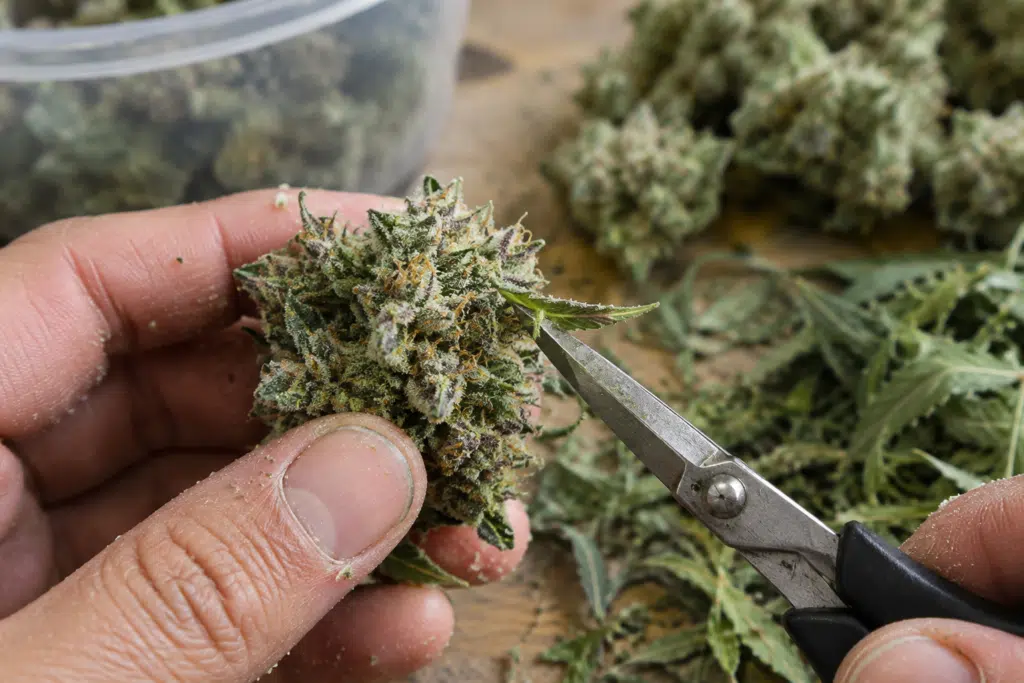
Sugar leaves are the small leaves growing directly out of the bud itself, often dusted in trichomes. This is what wet trim versus dry trim actually decides, when you remove the sugar leaves, not the fan leaves. A middle-ground approach some growers use, pulling only what has a visible stem and leaving the rest, is really just fan-leaf removal on its own timeline, separate from the wet-versus-dry decision entirely.
The Bro-Science
Ask ten growers and you’ll get ten confident answers. Wet trim fans like the speed, fresh material cuts clean and the whole job is done same day. Dry trim fans talk about a “moisture cocoon,” the idea that leaving sugar leaves on slows the dry and protects the bud from drying too fast on the outside while the inside is still wet, something growers call case hardening. Desert growers especially swear by this. Humid-climate growers often swear by the opposite, pulling leaves early to cut down on trapped moisture.
Both sides have a point, and as you’ll see below, both are onto something real about their own environment, just not the universal law either side thinks it is.
What the Actual Science Found
A 2024 study in Medical Cannabis and Cannabinoids tested pre-drying versus post-drying trimming directly. Dry trim won on terpenes. Wet trim won on cannabinoid concentration. Same plant, different winner depending on what you’re measuring. Read the study.
The researchers’ own explanation for wet trim’s cannabinoid edge points to stress signals from cutting live tissue, mechanical damage is a known trigger for cannabinoid production in cannabis. Our own guess is simpler: dried trichomes are brittle, and dry trim means more handling of that fragile, already-dried material. Wet trim’s quicker, gentler cut on fresh, pliable tissue may just knock fewer trichomes off in the process.
A 2023 study in Frontiers in Microbiology tracked mold and yeast levels across more than 2,000 samples over three years. Wet-trimmed flower came out significantly dirtier than dry-trimmed, hang-dried flower. The likely reason: wet trimming cuts into fresh, moist tissue, and that fresh wound is an easy foothold for microbes. Removing sugar leaves does cut trapped moisture, but the cut itself creates its own risk. Read the study.
Put together: if you care about flavor, dry trim has real evidence behind it, twice over. If you care most about raw potency, wet trim has a real edge too.
Our Take
If flavor is the priority, and for most home growers it is, dry trim is the better default. The science backs it on two fronts, better terpene retention and lower mold risk, and that’s enough for us to land there. It’s our own method of choice too, a couple percentage points of extra cannabinoid content isn’t worth trading away the flavor and aroma that make growing your own worth it in the first place.
The one exception is a genuinely humid, poorly ventilated space. If you’re fighting real bud rot risk and can’t fix your airflow, thinning the plant earlier is still a reasonable tool, even with the wound-site tradeoff above. Fix the room if you can. Our growing guide and drying and curing guide cover building one from scratch, and how much material you’re working with matters too, wet trim’s speed is a real advantage on a large harvest even for a dry-trim household.
Either way, clean tools and clean hands at the moment you cut matter more than which team you’re on.
FAQ
What is the difference between fan leaves and sugar leaves?
Fan leaves are the large leaves growing off the main stem, with almost no trichomes. Sugar leaves grow directly out of the bud and are often coated in trichomes. Fan leaves come off at harvest regardless of method, sugar leaves are what wet trim versus dry trim actually affects.
How do you trim cannabis?
Remove the large fan leaves first, they come off regardless of method. Then decide when to remove the sugar leaves, right after harvest for a wet trim, or after the plant has fully dried for a dry trim. Either way, work with clean, sharp scissors and handle the buds gently to avoid knocking off trichomes.
Does wet trimming cause more mold than dry trimming?
Yes, according to a Frontiers in Microbiology study of over 2,000 samples. Wet-trimmed flower had significantly higher mold and yeast levels than dry-trimmed flower, likely because fresh cuts on moist tissue give microbes an easier point of entry than a cut on already-dried material.
Is dry trim better for flavor?
Yes. A 2024 study found post-drying trimming produced the highest terpene content of the methods tested, and terpenes are what carry a strain’s flavor and aroma. The same study found wet trimming produced higher cannabinoid concentration, so the “better” method depends on what you’re optimizing for.
Is wet trim actually safer in humid climates?
Not as clearly as the common theory suggests. Removing sugar leaves early does reduce trapped moisture, but published research found the fresh cuts from wet trimming carry their own measurable mold risk. Both methods carry some risk in humid conditions, just from different causes.
Should I choose wet trim or dry trim based on my climate?
For flavor, dry trim is the better default regardless of climate. In a genuinely humid, poorly ventilated space where bud rot is a real risk, wet trim’s earlier leaf removal is still a reasonable tool, even with its own tradeoffs.
Ready to grow something worth trimming? Browse our full catalog, or start with our growing guide.

Matt, Co-Founder of Triangle Seeds — Matt has been growing commercially since 2013 alongside co-founder Chase. Over a decade, Triangle Seeds has sold over a million seeds to home growers and hemp farmers across the US. We ship nationwide. Call/text (919) 410-6945. Learn more
We have a video series with cannabis content creator Catherine Goldberg, aka Senior Savvy Cannabis, where we guide her through her first indoor grow. If you are a new grower, you might find the videos helpful. Watch the grow videos →