
Author: Matt Spitzer | Updated September 2026
Cannabis trichomes are the tiny resin glands that make almost everything you care about in a flower: the cannabinoids, the terpenes, and the resin that becomes hash and rosin. Most growers learn to read trichome color as a harvest signal, and our when to harvest guide covers how to make that call alongside weather and bud rot. This post goes deeper into the trichomes themselves. It starts with what they are and how to read them, then covers how harvest timing shapes effect and aroma, and finishes with what to look for if you plan to make hash or rosin.
Quick Answers
| Question | Short answer |
|---|---|
| What are trichomes? | Resin glands on the flowers and leaves where cannabinoids and terpenes are made and stored. |
| Which trichomes matter most? | Capitate-stalked trichomes, the large heads on visible stalks that cover mature buds. |
| What does clear mean? | The gland is still filling. Too early to harvest. |
| What does cloudy mean? | The gland is full and mature. This is the main harvest window. |
| What does amber mean? | The gland is aging. Heads are secreting resin, oxidizing, and starting to collapse. |
| Does color change the effect? | Growers commonly associate more amber with a heavier, more relaxed effect, but the research behind that is thin. |
| Do terpenes change with maturity? | Yes. The profile shifts as flowers ripen, and overripe glands lose some of their lighter aromatics. |
| Sandy or greasy? | Sandy resin means intact heads that wash well. Greasy resin smears and usually washes poorly. |
| Harvest early for hash? | Harvest at peak cloudy with little to no amber, which is earlier than many flower growers wait, but never at clear. |
Table of Contents
- What Are Trichomes
- The Three Types of Cannabis Trichomes
- What Trichome Color Tells You
- How to Check Your Trichomes
- How Trichome Color at Harvest Shapes the Effect
- Do Terpenes Change as Trichomes Mature
- How Trichomes Feel Between Your Fingers
- Which Trichomes Make the Best Hash and Rosin
- Should You Harvest Early for Hash or Rosin
- FAQ
What Are Trichomes
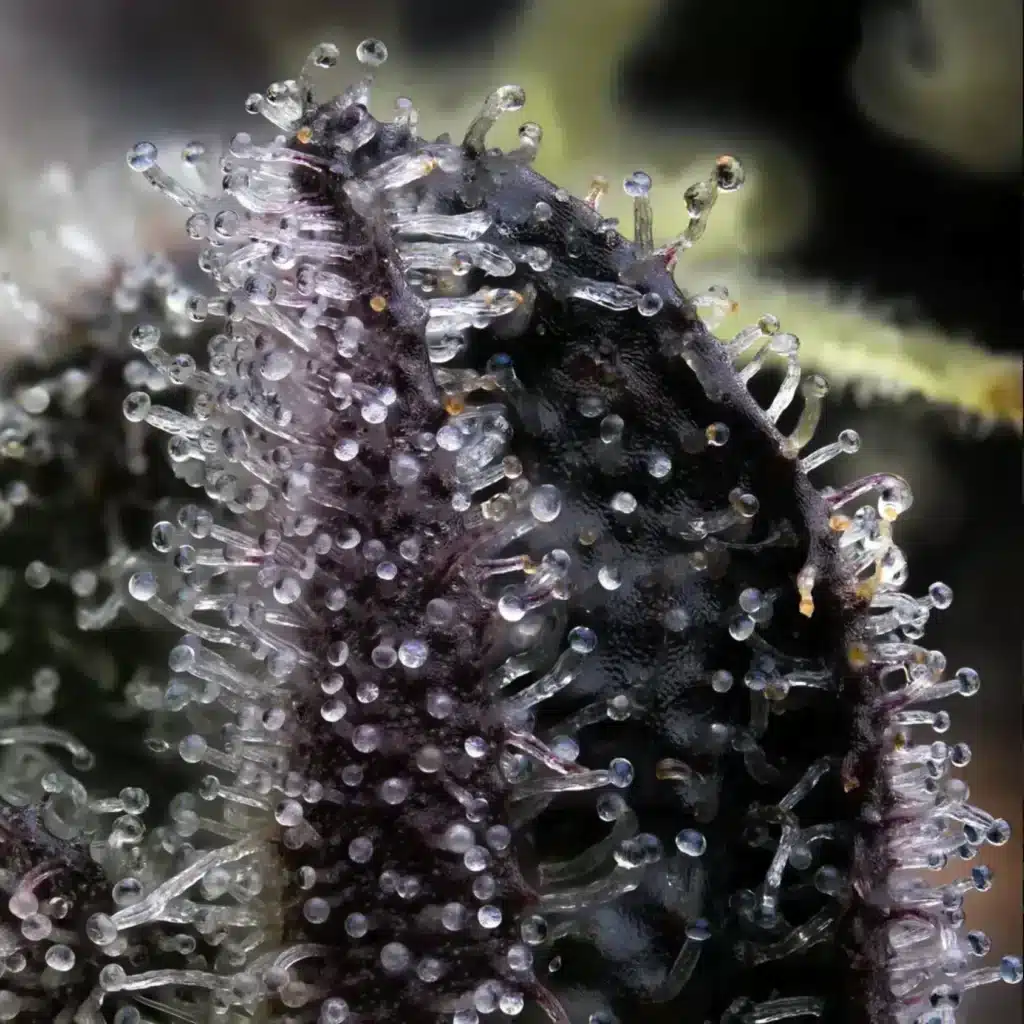
Trichomes are small outgrowths on the surface of the plant. Some are simple hairs that do nothing but physically protect the leaf. The ones growers care about are glandular trichomes, which work like tiny chemical factories. A ring of secretory cells at the base of each head produces cannabinoids and terpenes and pushes them up into a storage cavity under a thin, waxy skin called the cuticle. That cavity is the shiny bulb you see under a loupe.
The plant makes this resin for its own reasons: deterring insects, protecting flowers from UV light, and slowing water loss. We just happen to like what it makes. Glandular trichomes are concentrated on the bracts and calyxes of female flowers, which is one reason every seed we sell is a feminized seed. An unpollinated female spends her flowering stage building resin instead of seeds.
Not every glandular trichome is the same, though, and the differences explain a lot about color, aroma, and hash.
The Three Types of Cannabis Trichomes
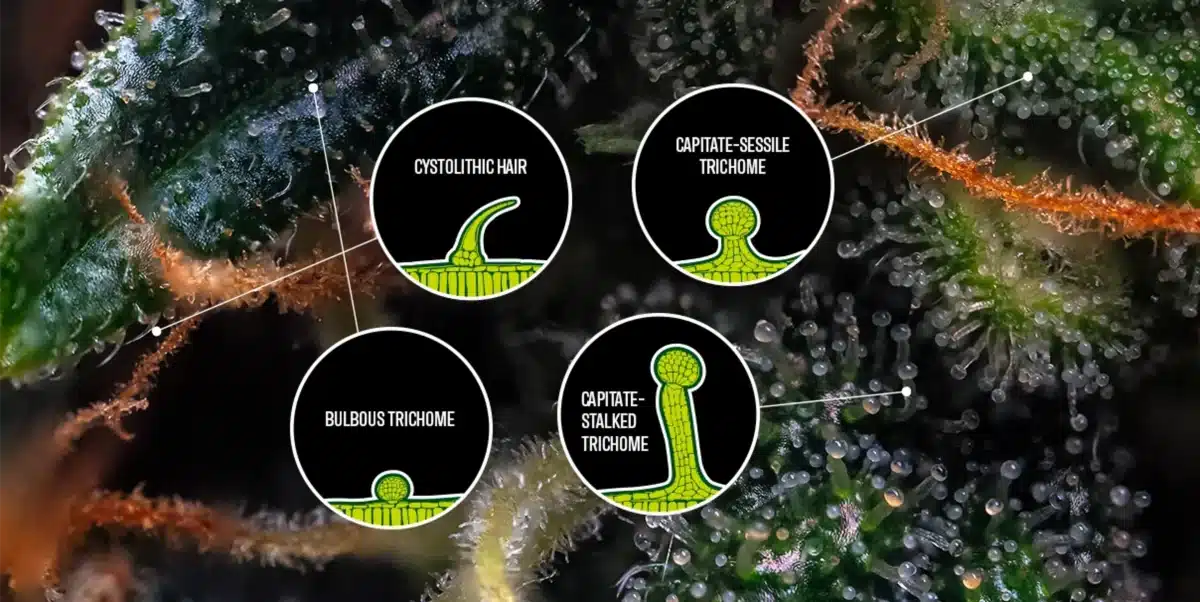
Cannabis has three kinds of glandular trichomes. Under a loupe they can look alike, but they differ in size, where they grow, and what they produce.
| Type | Head size | Where you find them | What they mean for you |
|---|---|---|---|
| Bulbous | Roughly 15 to 30 microns | Scattered across leaves, stems, and flowers | Too small to matter much for potency or hash |
| Capitate-sessile | Medium, sits nearly flat on the surface | Fan leaves, sugar leaves, and young flowers | Many on the flowers are stalked trichomes that have not grown their stalk yet |
| Capitate-stalked | Roughly 40 to 110 microns, on a visible stalk | Calyxes and bracts of maturing flowers | The main source of cannabinoids and aroma, and the heads hash makers want |
Bulbous Trichomes
Bulbous trichomes are the smallest of the three, a tiny head on a very short base. They show up all over the plant, including stems and fan leaves, but they are so small that you need a good microscope to pick them out. They hold very little resin, so they do not affect potency, aroma, or hash yield in any way you will notice.
Capitate-Sessile Trichomes
Capitate-sessile trichomes have a round head that sits almost directly on the leaf or bract with little or no visible stalk. They are common on leaves and on flowers early in the flowering stage.
A 2020 study published in The Plant Journal changed how researchers think about this type. The authors found that most of the sessile-looking trichomes on young flowers are not a separate type at all. They are an early stage of stalked trichomes. As the flower matures, they grow a stalk, add secretory cells, and get bigger. If you look at a bud in the third or fourth week of flowering and see mostly flat-sitting heads, you are looking at future stalked trichomes.
Capitate-Stalked Trichomes
Capitate-stalked trichomes are the classic mushroom shape: a large round head on a visible stalk. They take over the calyxes and bracts as the flower ripens, and they are what gives a finished bud its frosted look. The same 2020 study found their heads had 12 to 16 secretory cells compared to 8 in true sessile trichomes, and that they produced a strongly monoterpene-dominant aroma profile. They are the trichomes you judge harvest by, the ones behind most of the aroma, and the ones that end up in hash.
What Trichome Color Tells You
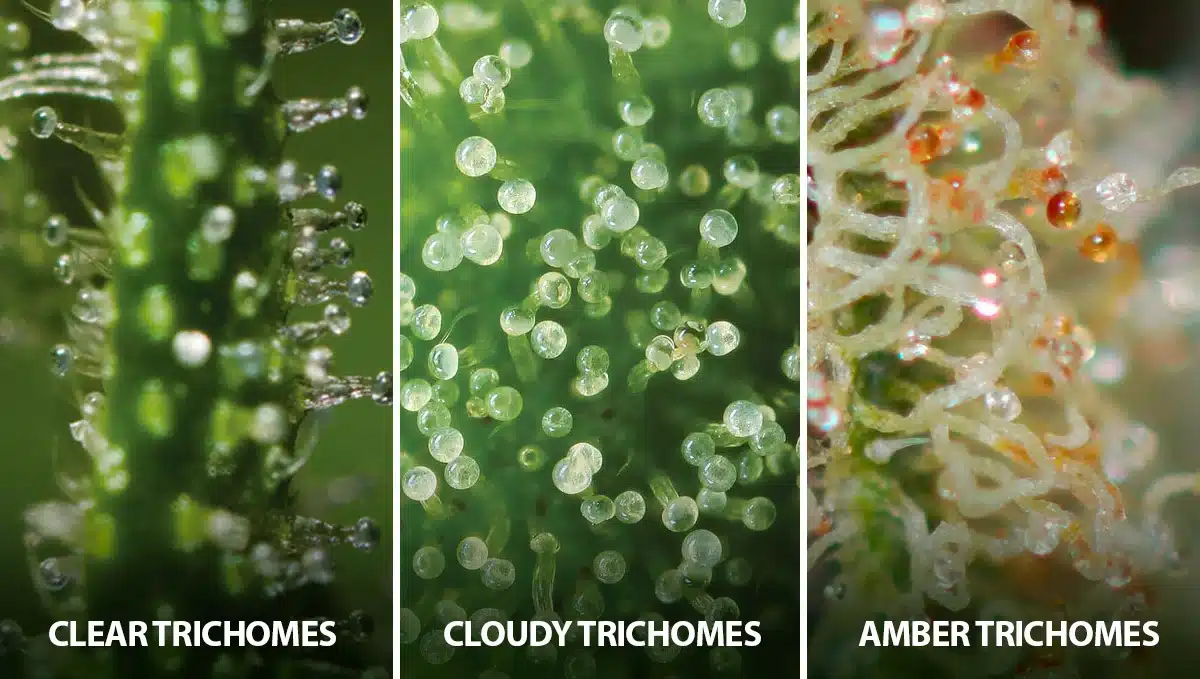
The color change happens in the heads of the stalked trichomes, and each stage tells you something different about what is happening inside the gland.
Clear Trichomes
A clear head looks like a tiny glass bead. The secretory cells are still filling the storage cavity, and cannabinoid and terpene content is still climbing. Harvesting at mostly clear costs you both weight and potency.
Cloudy Trichomes
A cloudy head is opaque and milky white. The gland is full. For most growers this is the target, and the window typically lasts a week or two depending on the strain and growing conditions.
Amber Trichomes
An amber head has turned gold to brown. The common explanation is that THC is turning into CBN, but that is only part of the story.
A 2023 study in the Journal of Cannabis Research tracked stalked trichomes under a scanning electron microscope from week 3 to week 8 of flowering. As heads matured, they started secreting droplets of resin through the cuticle. Heads stuck together, shrank, wrinkled, and eventually collapsed or broke off the stalk entirely. That collapse lined up with the amber color, which the authors attribute mostly to oxidation of phenolic compounds inside the head.
So amber is best read as a sign of aging glands. Some THC does degrade as the gland ages, but most of the CBN in cannabis forms after harvest, when dried flower sits exposed to air, light, and heat over time. Amber heads on a living plant mark glands that are past their peak, not a switch that turns your harvest into a CBN product.
One caution. Heat and drought stress can push trichomes amber early, sometimes weeks before the flower is actually mature. Amber on a stressed plant does not always mean ripe.
How to Check Your Trichomes
Knowing what the colors mean only helps if you read them accurately. A few habits keep you from harvesting on bad information.
- Get magnification. A 60x jeweler’s loupe or a small USB or handheld microscope works. This is the handheld microscope we use.
- Look at the calyxes, not the sugar leaves. Sugar leaf trichomes run ahead of the buds and will make you harvest too early.
- Sample several spots. Check the top cola, a mid-plant bud, and a lower bud. Tops usually ripen first.
- Check every two or three days once cloudy heads appear. The window moves faster than most new growers expect.
How Trichome Color at Harvest Shapes the Effect
Once you can read the colors, the next question is where in the window to cut. Most growers pick a harvest point based on the experience they want:
- Mostly cloudy, almost no amber. Commonly associated with a brighter, more energetic, head-focused experience.
- Mostly cloudy, 10 to 20 percent amber. The range most growers aim for, often described as balanced.
- Heavy amber, 30 percent or more. Users commonly report a heavier, more relaxed, body-focused effect.
We could not find controlled human research that isolates trichome color as the cause of a different effect. The pattern growers describe shows up again and again in grow journals, but the reasons are probably a mix of things rather than CBN alone:
- Later harvests carry a different terpene balance, and terpenes are widely associated with how a strain feels. The next section covers how that balance shifts.
- Aging glands have secreted and lost some of their contents, which changes the overall chemistry of the flower.
- Genetics set the ceiling. An energetic, terpinolene-forward strain will not turn into a couch strain because you waited two extra weeks. It will just get a little heavier and lose some brightness.
Harvest timing adjusts the character of a strain. It does not rewrite it. If you want a specific kind of experience, choosing the right genetics does far more than choosing the right week, and our strain selection guide is the place to start. THC percentage is also not the signal to chase. A flower harvested at peak cloudy with a rich terpene profile will usually be more enjoyable than one that tested a point higher.
Do Terpenes Change as Trichomes Mature
Yes, and in a fairly predictable direction.
Early in flowering, the aroma profile leans toward sesquiterpenes, the heavier molecules behind spicy, woody, and earthy notes like caryophyllene and humulene. As flowers mature, the balance shifts toward monoterpenes, the lighter molecules behind citrus, pine, and fruit notes like limonene, pinene, myrcene, and terpinolene. Field research on hemp cultivars found total terpene content increased with maturation, with sesquiterpenes dominating early flowering and monoterpenes dominating by the end.
The trichome types explain why. As sessile heads grow into stalked trichomes, the flower gains more of the monoterpene factories described earlier, and the nose gets brighter.
The catch is what happens past peak. Monoterpenes are the most volatile compounds in the flower. Once glands start secreting resin and collapsing, the lightest aromatics are the first to escape. That is why an overripe plant can smell muted compared to the same plant a week or two earlier, and why many growers notice fruit and citrus notes fading in favor of earthier, spicier ones on a late harvest.
The same volatility is why post-harvest handling matters so much. Heat during drying drives off monoterpenes fast. Our dry and cure guide covers how to hold onto the terpenes you waited all season for, and our terpene chart breaks down the common terpenes by aroma.
How Trichomes Feel Between Your Fingers
Everything above is about growing flower. If you plan to make hash or rosin, how the resin behaves matters as much as how it looks, and the fastest way to judge that is by feel.
Rub a ripe bud gently between your thumb and finger and you will notice a difference from strain to strain. Some flowers feel gritty, almost like fine sand. Some leave a slick, oily film. Some are tacky enough to glue your fingers together. Plenty land somewhere in between.
It is tempting to match each feel to one of the three trichome types, but it does not work that way. Bulbous and sessile heads are too small to feel. What your fingertips are reading is almost entirely the stalked heads, and specifically two things about them: whether the heads are intact or broken open, and what the resin inside them is like.
| Feel | What is usually going on | What it tends to mean |
|---|---|---|
| Sandy or gritty | Lots of large, intact stalked heads with firm skins that roll off the bract whole | Heads detach cleanly. This is the classic sign of a strong hash strain |
| In between | Gritty at first, then turns tacky as your fingers warm the heads | Intact heads with resin that still melts. Often an ideal balance for rosin |
| Greasy | Heads with thin or weak skins bursting under light pressure, releasing oily resin | Resin smears instead of separating. Usually a poor washer, even if the flower is excellent |
| Sticky or tacky | Resin already sitting outside the heads, from mature glands secreting or heads that have broken | Common late in flowering and on heavily handled buds. Fine for flower, messy for washing |
Sandy means intact heads. When stalked heads are full, firm, and have a weak neck where they meet the stalk, they break off whole and roll under your fingers like grit. Each grain you feel is a head that kept its resin sealed inside. Hash makers look for exactly this feel when they rub a plant late in flowering, because heads that come off whole in your fingers will come off whole in ice water too.
Greasy means the heads are opening. If the cuticle on each head is thin, light finger pressure ruptures it and spills the resin onto your skin. Resin that is rich in terpenes and oils feels slick rather than gritty. That same flower can smell and smoke great. In a wash, though, those heads smear, clog the bags, and drag plant material with them.
Sticky means resin is already on the surface. This is the same secretion the 2023 microscopy study documented on amber heads: resin droplets pushing through the skin and neighboring heads gluing together. It is part of why a plant that felt sandy at week six can feel tacky at harvest, and why buds that have been handled a lot feel stickier than untouched ones.
Temperature changes the feel too. Resin softens as it warms, so the same bud feels grittier straight from a cold room than after a minute in your warm hand. This is the reason hash makers work cold. A frozen head is brittle and snaps off. A warm one smears.
Growers who wash also use a quick follow-up called the string test. Collect a small pinch of resin from your fingers, warm it, and pull it apart. Resin that starts sandy, then stretches into a thin string before breaking, tends to melt well. Resin that stays crumbly or powdery usually presses poorly. None of this replaces a small test wash in a jar of ice water, but it will tell you in thirty seconds which plants are worth testing.
Which Trichomes Make the Best Hash and Rosin
Hash and rosin are both about collecting trichome heads. Bubble hash separates them from the plant with ice water and agitation, then catches them in a stack of mesh bags sized in microns. Rosin presses resin out with heat and pressure, either straight from flower or, for the best results, from hash.
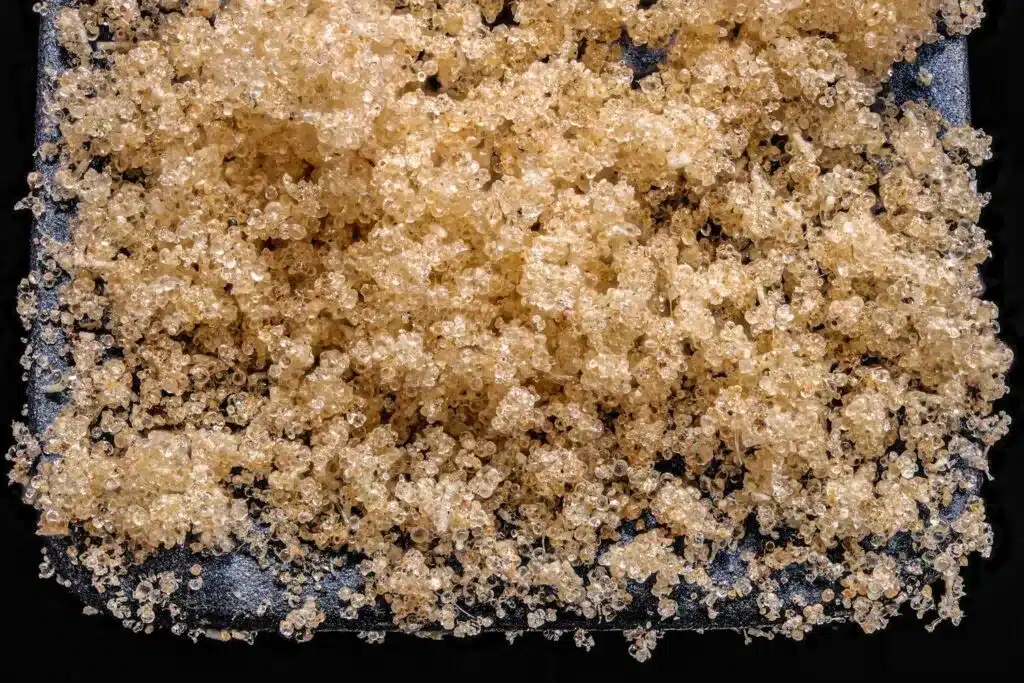
The heads you want are mature capitate-stalked trichomes. They are the biggest, they hold the most resin, and they carry the monoterpene-rich aroma. They also break off cleanly. The stalk narrows right where it meets the head, so a cold, brittle, full head snaps off at that neck with gentle agitation. Bulbous and sessile heads mostly pass through the finer bags.
In a typical wash, the most prized material collects in roughly the 73 to 120 micron bags. Those grades are often called full melt when they are clean enough to melt with little residue, and they make the best rosin. Larger bags catch more plant material. Smaller bags catch immature heads and fragments that press darker and dirtier.
Genetics matter more than most growers expect. Some strains that look frosty on the plant wash poorly because their heads do not release easily or break apart during agitation. Head size, stalk strength, and how readily heads detach are all genetic. If hash or rosin is the goal, pick a strain known for resin output rather than assuming any frosty plant will wash well, and use the feel test above to sort your own plants.
Should You Harvest Early for Hash or Rosin
Earlier than a flower grower, yes. Early in the sense of clear trichomes, no.
Most solventless makers harvest at or just after peak cloudy, with little to no amber, and freeze the material right away rather than drying it. Everything earlier in this post points to the same three reasons.
Intact heads wash better. Once heads start secreting resin, they get sticky, glue themselves together, and trap plant material. Collapsed and brittle heads break into fragments that fall into the wrong bags. Heads that have already detached on the plant are simply lost.
Aroma is brightest around peak cloudy. Waiting for amber trades away the lightest aromatics, and concentrating resin concentrates whatever aroma you started with, good or flat.
Color carries through. Amber and oxidized heads press darker. Lighter, brighter hash usually comes from material taken at peak cloudy.
Where growers go wrong is cutting so early that the heads are still clear and undersized. Immature heads are small, hold less resin, and land in the lower micron grades. You give up yield for no gain.
If you are making both flower and hash from the same garden, take the plants you plan to wash a few days earlier, at peak cloudy, and let the flower plants run to your preferred amber level. The weather rule from our when to harvest guide still applies. If a storm or bud rot is forcing your hand, take the harvest. A slightly early wash beats a moldy one.
FAQ
What are trichomes on cannabis? Trichomes are tiny resin glands on cannabis flowers and leaves. The glandular ones produce and store cannabinoids and terpenes in a small head that sits on the plant surface.
What are the three types of trichomes? Cannabis has bulbous, capitate-sessile, and capitate-stalked trichomes. Bulbous are the smallest and matter little. Many sessile trichomes on young flowers are stalked trichomes that have not grown their stalk yet. Capitate-stalked trichomes are the large heads on visible stalks that produce most of the cannabinoids and aroma.
What do clear trichomes mean? Clear trichomes mean the gland is still filling with cannabinoids and terpenes. Harvesting at mostly clear costs you both weight and potency.
What do cloudy trichomes mean? Cloudy trichomes mean the gland has filled and matured. Most growers treat mostly cloudy trichomes as the start of the harvest window.
What do amber trichomes mean? Amber trichomes are aging glands. Research shows mature heads secrete resin, oxidize, shrink, and eventually collapse or detach, and the amber color tracks with that aging. Growers commonly associate more amber with a heavier, more relaxed effect.
Do sugar leaf trichomes mature at the same rate as bud trichomes? No. Sugar leaf trichomes usually turn amber before the trichomes on the calyxes, so always check the buds themselves when timing a harvest.
Does harvesting later make weed more sedating? Many growers report a heavier, more body-focused effect from later harvests with more amber trichomes. Controlled research on this is limited, and genetics have a much bigger influence on effect than harvest timing does.
Do terpenes change as the plant matures? Yes. The terpene balance shifts from heavier sesquiterpenes early in flowering toward lighter monoterpenes by the end. Past peak ripeness, the lighter monoterpenes are the first to be lost as trichome heads start to break down.
Why do some buds feel sandy and others feel greasy or sticky? Sandy buds are covered in large, intact trichome heads that roll off whole. Greasy buds have thin-skinned heads that burst and release oily resin under light pressure. Sticky buds have resin already on the surface from mature heads secreting or breaking. Sandy resin usually makes the best ice water hash.
What trichomes are best for making hash? Mature capitate-stalked trichomes are best for hash. They have the largest heads, hold the most resin, and snap off cleanly when cold. Most of the best ice water hash comes from roughly the 73 to 120 micron bags.
Should you harvest early for rosin or hash? Harvest at peak cloudy with little to no amber, which is earlier than many flower growers wait. Do not harvest at clear, because immature heads are small and hold less resin.
Ready to grow something worth putting under a loupe? Browse our full seed catalog.

Matt, Co-Founder of Triangle Seeds — Matt has been growing commercially since 2013 alongside co-founder Chase. Over a decade, Triangle Seeds has sold over a million seeds to home growers and hemp farmers across the US. We ship nationwide. Call/text (919) 410-6945. Learn more
We have a video series with cannabis content creator Catherine Goldberg, aka Senior Savvy Cannabis, where we guide her through her first indoor grow. If you are a new grower, you might find the videos helpful. Watch the grow videos →