

Last updated: April 2026
If you search “how much water does a cannabis plant need,” you’ll find a lot of posts telling you to water every 2–3 days. That number is essentially useless without context. A seedling in a 1-gallon pot needs water far less often than a mature plant in a 15-gallon fabric pot in 90-degree summer heat. A plant in dense potting soil holds moisture much longer than one in Pro-Mix or coco coir.
The honest answer is: there is no fixed schedule. What there is, is a reliable method for reading your plants and your medium to know exactly when to water. That’s what this guide covers.
Quick Answer
| Growth Stage | Watering Frequency (container) | Amount per Watering |
|---|---|---|
| Seedling (0–2 weeks) | Every 2–3 days or as needed | Small amount around the stem, not the whole pot |
| Vegetative growth | Every 2–4 days | Until 10–20% runoff from drainage holes |
| Flowering | Every 1–3 days (increases as plant matures) | Until 10–20% runoff |
| Late flower/flush | Every 1–2 days | Until full runoff |
| Outdoor in-ground | Varies widely by climate and rainfall | Deep, infrequent watering is better than frequent shallow watering |
These ranges are starting points only. The lift-the-pot method and visual cues are more reliable than any schedule.
Table of Contents
- Why there’s no fixed watering schedule
- The lift-the-pot method
- How much water to give each time
- Watering by growth stage
- Outdoor watering
- Overwatering: signs, causes, and fixes
- Underwatering: signs and fixes
- Water quality and pH
- FAQ
Why There’s No Fixed Watering Schedule
Every guide that tells you to water every 2–3 days is making assumptions about your setup that may not be true. How often your plant needs water depends on:
Container size. A plant in a 3-gallon pot dries out faster than the same plant in a 10-gallon pot. More soil volume holds more moisture.
Growing medium. Coco coir dries out faster than soil and typically needs watering daily or every other day. Pro-Mix, which we use at Triangle Seeds, dries out faster than a dense potting mix like Fox Farm Ocean Forest. Native soil outdoors holds moisture longest of all.
Plant size. A large plant in vegetative growth or peak flowering is transpiring (releasing water vapor through its leaves) at a much higher rate than a seedling. Larger plants drink more, faster.
Environment. Heat, low humidity, and strong airflow all accelerate how fast a growing medium dries out. A plant in a 90-degree greenhouse in July needs water more often than the same plant in a 70-degree basement grow room.
Container type. Fabric pots dry out faster than plastic pots because they breathe through the sides and bottom. This is actually a benefit for root health, but it does mean more frequent watering.
Because all of these variables interact, any schedule someone else uses may not apply to your grow. The method below removes the guesswork.
The Lift-the-Pot Method
The most reliable way to know when to water is to lift the container and judge by weight. A dry pot feels noticeably lighter than a freshly watered one. Once you’ve done this a few times, you’ll develop an intuitive sense of when your plants are ready.
Here’s how to calibrate it:
- Water your plant thoroughly until you see runoff from the drainage holes.
- Lift the pot immediately and note the weight. This is your “wet” baseline.
- Check and lift the pot daily. When it feels significantly lighter, it’s time to water.
- Over several waterings, you’ll get a feel for exactly where the sweet spot is for your setup.
At Triangle Seeds, we combine this method with a watering timer that we adjust daily based on what the plants are telling us. The timer handles consistency, the lift test handles accuracy. Neither one alone is as reliable as both together.
One important note: you’re not waiting for the pot to feel completely empty before watering. You want to let the growing medium dry out enough that roots have a chance to breathe and seek out moisture, but not so dry that the plant shows drought stress. The goal is a wet-to-dry cycle, not constant saturation and not bone-dry soil.
How Much Water to Give Each Time
When you do water, water thoroughly. The goal is to wet the entire root zone, not just the surface.
For container growing, water until you see 10–20% of what you put in draining out of the bottom. This runoff serves two purposes: it confirms the entire medium is saturated, and it flushes any salt buildup from nutrients out of the root zone.
If water runs straight through almost immediately, your medium may be too dry or hydrophobic (repelling water). If this happens, water slowly in small increments to allow the medium to reabsorb moisture gradually before it can pass through.
If you’re not seeing any runoff at all, you’re likely not giving enough water per session. Plants that never receive runoff can develop salt and nutrient buildup at the bottom of the pot over time.
A practical rule of thumb for container volume: water with approximately 25–30% of your container’s volume per watering. A 5-gallon pot gets roughly 1.25–1.5 gallons per session. Adjust based on what the plant and medium are telling you.
Watering by Growth Stage
Seedlings (weeks 0–2)
Seedlings have a small, undeveloped root system that can’t absorb large amounts of water. The most common seedling mistake is watering the entire pot when the roots only occupy a small area near the stem.
Water in a small circle around the seedling, not the whole pot surface. Use a gentle stream or a spray bottle. The goal is to keep the medium around the roots consistently moist without waterlogging. Let the surface dry slightly between waterings to encourage roots to grow downward in search of moisture.
Vegetative growth
Once plants are established and roots have spread through more of the medium, you can begin watering the whole pot. Water frequency increases as the plant grows and transpiration rates climb. A plant doubling in size every week during aggressive vegetative growth is consuming significantly more water than it was two weeks earlier.
This is also where the lift-the-pot method becomes your primary tool. The pot will feel noticeably lighter each day as the plant drinks. Watch for the medium to dry to about 50–75% of the pot depth before watering again.
Flowering
Water demand increases as plants enter flowering and buds develop. Large, healthy plants in peak flowering may need water every one to two days depending on environment and container size. Continue using runoff as your guide.
One caution during late flower: excess moisture at the canopy level (not root level) increases mold risk. Water at the base of the plant, not overhead, and ensure good airflow to keep the canopy dry.
Late flower and pre-harvest
Some growers reduce watering frequency slightly in the final 1–2 weeks before harvest to mildly stress the plant and encourage resin production. The science on this is mixed. What’s well-established is that reducing water too aggressively causes drought stress that can hurt quality. A mild reduction is more reasonable than stopping water entirely.
If you’re flushing before harvest (running plain pH-balanced water through the medium to clear nutrient buildup), you’ll actually water more heavily during this period, not less.
Outdoor Watering
Outdoor growing introduces variables that indoor growing doesn’t have: rainfall, temperature swings, sun intensity, and wind. These change daily and make any fixed schedule even less reliable.
Container outdoor grows follow the same principles as indoor container growing, with one key difference: outdoor plants in summer heat dry out significantly faster than indoor plants. A plant in a 15-gallon fabric pot on a hot, sunny day may need water daily or even twice daily at peak size in flowering. Lift the pot in the morning and again in the afternoon during heat waves.
In-ground outdoor grows have access to a much larger soil volume, which buffers moisture significantly. In-ground plants in most climates can go several days to a week between waterings, depending on rainfall and heat. Deep, infrequent watering is better than frequent shallow watering for in-ground grows. Deep watering encourages roots to grow downward, which makes plants more drought-tolerant and more stable structurally.
Water in the early morning before the hottest part of the day. This gives roots time to absorb moisture before peak evaporation and avoids keeping foliage wet overnight, which increases mold risk.
Rainfall. If it rains, check your soil before watering. Waterlogged outdoor plants are just as problematic as waterlogged container plants. In humid climates, overwatering from rainfall combined with poor drainage is a real risk. See our post on why cannabis leaves turn yellow. Overwatering is one of the most common causes.
Overwatering: Signs, Causes, and Fixes
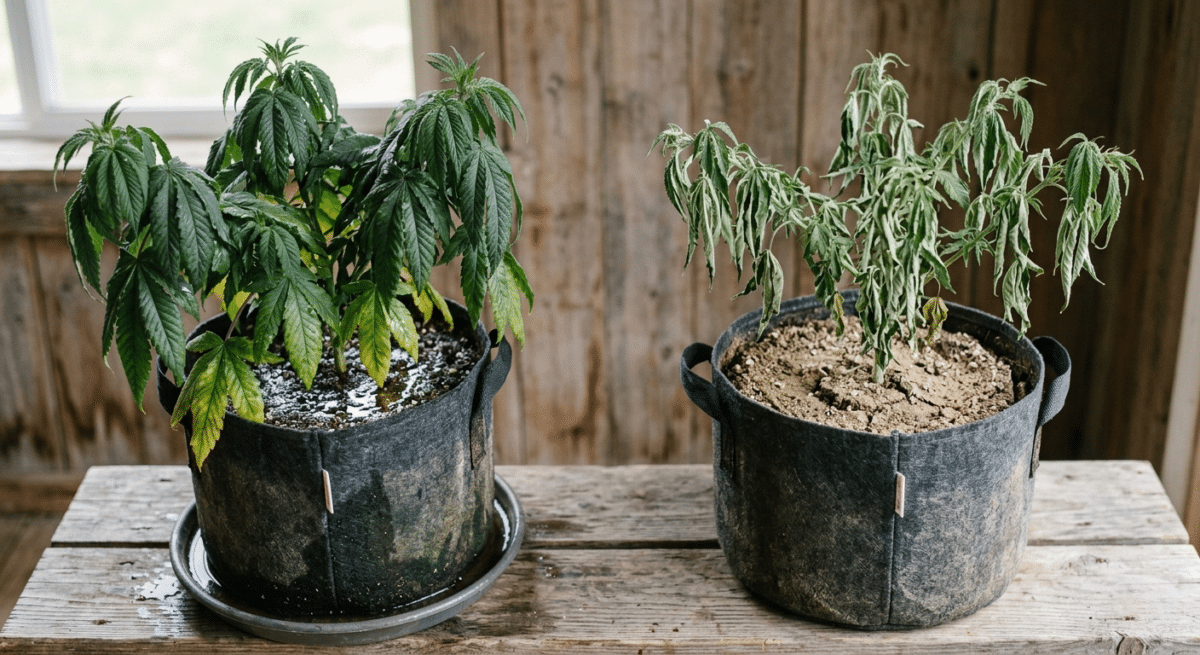
Overwatering is the most common mistake home growers make, and it’s not always about giving too much water at once. More often it’s about watering too frequently and not allowing the medium to dry out between sessions.
Signs of overwatering:
- Leaves droop or curl downward. With overwatering, drooping leaves typically feel firm or bloated rather than limp and papery (which is the feel of underwatered leaves).
- Yellowing that starts with lower leaves and spreads upward
- Slow growth despite adequate light and nutrients
- Soil stays wet for days after watering
- Fungus gnats hovering around the base of the plant (a reliable indicator of consistently moist topsoil)
- In severe cases: root rot, which produces a dark, slimy root system and a foul smell from the medium
What causes it:
Watering on a fixed calendar schedule rather than reading the plant and medium. Pots without drainage holes. Dense growing medium with no perlite. Containers that are too large for the plant’s current root system (roots can’t dry the medium fast enough).
How to fix it:
Stop watering and let the medium dry out more completely than usual before the next watering session. Improve drainage if needed by adding perlite to your mix. If roots are in bad shape, a beneficial microbe product (such as Hydroguard or similar) can help restore root zone health. See our cannabis soil guide for more on drainage and medium selection.
Underwatering: Signs and Fixes
Underwatering is less common than overwatering but easier to misdiagnose. Plants that are slightly underwatered can look similar to plants with other stress issues.
Signs of underwatering:
- Leaves droop or wilt, but feel limp and papery rather than firm
- Dry, pulling-away-from-pot-edges soil
- Pot feels extremely light when lifted
- Slow growth and pale coloring in severe cases
How to fix it:
Water thoroughly until you see runoff. If the medium has become hydrophobic (water runs straight through without absorbing), water slowly in multiple small passes to allow the medium to reabsorb. Plants typically recover from mild underwatering within a few hours of proper watering.
Water Quality and pH
The quality and pH of your water matters as much as how much you give. Cannabis in soil grows best when water pH is between 6.0 and 6.5. Water that’s too alkaline (most tap water runs 7.0–8.0) or too acidic causes nutrient lockout, where nutrients are present but unavailable to roots.
Test your tap water pH before using it. If it’s outside the target range, a basic pH adjustment kit (pH up or pH down solution) and a digital pH meter correct the issue quickly. This is one of the most impactful adjustments a new grower can make.
Tap water also contains chlorine, which can affect beneficial microorganisms in your growing medium. Letting tap water sit uncovered for 24 hours allows most chlorine to off-gas naturally. Alternatively, a basic carbon filter removes it immediately.
See our cannabis pH guide for a full walkthrough on testing and adjusting water pH.
FAQ
How often should I water cannabis plants? There is no universal answer. Frequency depends on container size, growing medium, plant size, and environment. The most reliable method is the lift-the-pot test: lift your container daily and water when it feels noticeably lighter. Most container-grown plants need water every 1–4 days depending on these variables.
How do I know if I’m overwatering my cannabis? The most reliable signs are drooping leaves that feel firm rather than limp, slow growth, and soil that stays wet for more than 3–4 days after watering. Fungus gnats near the base of the plant are another reliable indicator of consistently overwatered medium.
How do I know if I’m underwatering my cannabis? Underwatered plants droop with limp, papery leaves rather than the firm drooping of overwatering. The pot will feel very light and the soil surface will be dry and pulling away from the container edges.
What is the best time of day to water cannabis? Early morning is best for outdoor grows. It allows roots to absorb water before peak evaporation and keeps foliage dry overnight, reducing mold risk. For indoor grows, watering at the start of the light cycle is common practice.
Should I water cannabis until I see runoff? Yes, for container growing. Watering until 10–20% of what you put in drains out confirms the entire root zone is hydrated and helps flush salt buildup from nutrients. Never let plants sit in standing runoff water.
Does cannabis need more water during flowering? Yes. Water demand increases significantly during flowering as buds develop and the plant’s overall size and transpiration rate increases. Large plants in peak flower may need water every 1–2 days.
Is tap water safe for cannabis? Tap water is generally fine after adjusting pH and allowing chlorine to off-gas for 24 hours. Test your tap water pH before use. Most U.S. tap water runs between 7.0 and 8.0, which is too alkaline for cannabis. Adjust to 6.0–6.5 for soil.
About the Author

Matt, Co-Founder, Triangle Hemp – Matt has been growing plants commercially since 2013, starting with Endless Sun Farms before co-founding Triangle Hemp in 2017 alongside childhood friend Chase. Over more than a decade, Triangle Hemp has produced and sold over a million seeds to home growers, homesteaders, and hemp farmers across the United States. Matt and Chase manage seed selection personally, only carrying genetics we truly stand behind. Learn more about Triangle Hemp.
We have a video series with cannabis content creator Catherine Goldberg, aka Senior Savvy Cannabis, where we guide her through her first indoor grow. If you are a new grower, you might find the videos helpful. Watch the grow videos →