
Author: Matt Spitzer | Updated September 2026
Indica and sativa are the two main lineages of cannabis, and hybrid strains combine both. Indica-dominant plants grow short and finish flowering fast, sativa-dominant plants grow tall and take longer, and most seeds sold today are hybrids of the two. This guide covers what the labels actually predict for your grow, and the real history behind the names.
Key Takeaways
- Indica and sativa started as plant geography and structure labels, not effect categories.
- Indica-dominant strains grow shorter and typically finish flowering in 8 to 10 weeks.
- Sativa-dominant strains grow taller and often need 10 to 16 weeks to finish flowering.
- Most cannabis sold today is a hybrid of both lineages, not a pure indica or sativa.
- Reported effects depend more on a strain’s cannabinoid and terpene profile than its indica or sativa label.
Indica vs Sativa vs Hybrid at a Glance
| Indica | Sativa | Hybrid | |
|---|---|---|---|
| Plant height | 2 to 4 feet | 5 to 10+ feet outdoors | Between the two |
| Flowering time | 8 to 10 weeks | 10 to 16 weeks | Depends on the cross |
| Bud structure | Dense, tight | Loose, airy | Depends on the cross |
| Reported effects | More often associated with relaxing, calming experiences | More often associated with uplifting, energizing experiences | Depends on the cross |
| Best for | Short seasons, small spaces | Long seasons, lower humidity | New growers unsure which fits their setup |
Table of Contents
- What Is the Difference Between Indica and Sativa?
- Where Did the Words Indica and Sativa Come From?
- What Is a Hybrid Strain?
- Does Indica vs Sativa Predict How a Strain Feels?
- How Does Indica vs Sativa Affect How You Grow?
- Which Should You Grow: Indica, Sativa, or Hybrid?
- What Are Landrace Strains?
What Is the Difference Between Indica and Sativa?
Indica and sativa are two lineages of cannabis that evolved in different parts of the world, and the difference shows up mainly in how the plant grows, not how it makes you feel.
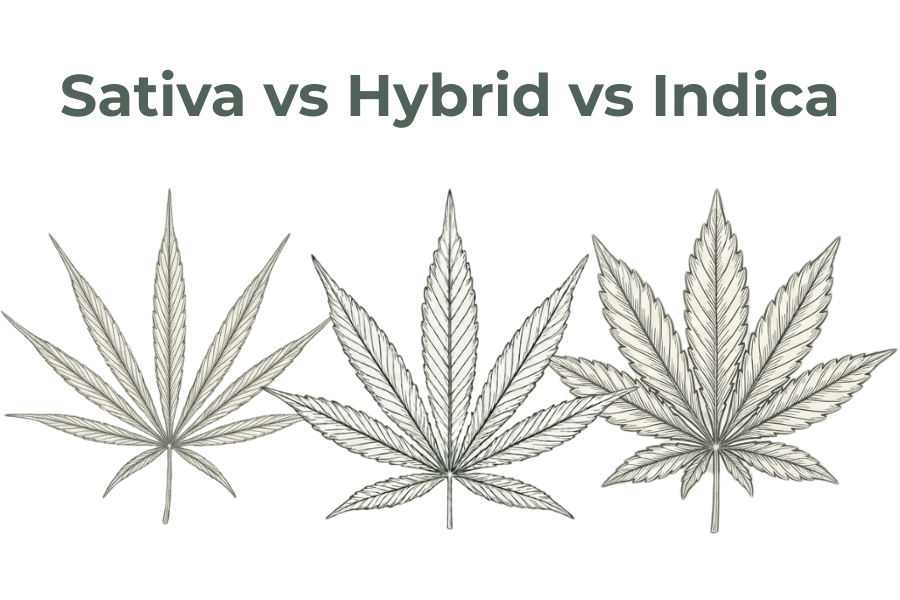
Indica-dominant plants stay short and bushy, usually finishing in 8 to 10 weeks. Sativa-dominant plants take the opposite approach: tall, airier structure, and often twice as long on the clock, 10 to 16 weeks. Hybrids land somewhere between the two, depending on which lineage dominates the cross.
The labels were originally botanical, describing plant shape and origin. The idea that indica relaxes you and sativa energizes you came later, and it is a much less reliable rule than most dispensary menus suggest. A strain’s specific cannabinoid and terpene profile predicts the experience far better than the indica or sativa label alone. If you are trying to figure out which fits your own space and season, our strain selection guide walks through it in more detail than this table can.
Where Did the Words Indica and Sativa Come From?
The words indica and sativa are botanical names from the 1700s, and neither one originally described an effect.
In 1753, Swedish botanist Carl Linnaeus classified cannabis as a single species, Cannabis sativa. Sativa is Latin for cultivated, and the plants he was describing were tall, fibrous, narrow-leafed hemp grown across Europe for rope and textile fiber, low in the compounds that produce intoxicating effects.
In 1785, French naturalist Jean-Baptiste Lamarck examined plant specimens collected in India that looked nothing like the European hemp Linnaeus had described. These were shorter, bushier, more heavily resinous plants with broader leaves. Lamarck named them Cannabis indica, Latin for “of India,” a geographic label, not a chemical one.
So from the start, the indica and sativa distinction was about where a plant grew and how it was built, not about its effects. That part got attached to the labels later, as cannabis culture spread and needed shorthand.
What Is a Hybrid Strain?
A hybrid strain carries genetics from both indica and sativa lineages, and most cannabis sold today falls into this category.
For most of cannabis history, indica and sativa landrace populations grew in geographic isolation. Afghan mountain strains never crossed with Colombian equatorial strains, because there was no contact between them. That changed in the 1960s and 1970s, when the counterculture movement moved seeds around the world, and breeders began crossing fast-finishing indica genetics with tall, terpene-rich sativa genetics.
Within a generation, deliberate crossbreeding became the norm. A strain labeled “indica-dominant” or “sativa-dominant” today usually means the plant leans toward one lineage’s traits, not that it is a pure, unmixed descendant of it.
- Indica-dominant hybrid: leans toward indica’s compact size and faster finish.
- Sativa-dominant hybrid: leans toward sativa’s height and longer flowering window.
- Balanced hybrid: falls close to the midpoint between the two in both growth and reported effects.
Does Indica vs Sativa Predict How a Strain Feels?
Loosely, but not as directly as most people assume, since the experience a strain produces has more to do with its specific cannabinoid and terpene profile than its indica or sativa label.
Two strains both labeled indica can produce noticeably different experiences. A strain’s terpene content, in particular, shapes a lot of what people report feeling. Myrcene is commonly associated with a more relaxing experience, while limonene and pinene are more often associated with an energizing one, regardless of whether the strain is labeled indica or sativa. Our terpene chart breaks down what each common terpene is associated with in more detail.
That said, the pattern people describe is real often enough that the shorthand persists: indica leaning toward relaxing, calming reports, sativa leaning toward uplifting, energizing ones. Treat it as a loose tendency, not a guarantee. Individual response varies from person to person.
How Does Indica vs Sativa Affect How You Grow?
Indica and sativa genetics predict plant height, flowering time, and how well the bud structure handles humidity, and these are the most useful things the labels tell a grower.
- Height. Indica-dominant genetics stay compact, typically 2 to 4 feet. Sativa-dominant genetics stretch, often reaching 5 to 10 feet or more outdoors, with a strong surge in height during early flowering.
- Flowering time. Indica-dominant strains typically finish in 8 to 10 weeks. Sativa-dominant strains often need 10 to 16 weeks, which can push outdoor harvest into October or November.
- Bud density and humidity. Indica buds grow dense and tight, which can trap moisture in humid conditions. Sativa buds are looser and more open, letting air move through the flower more easily.
For growers in the humid Southeast or Mid-Atlantic, that structural difference matters. A sativa-leaning strain’s airier buds can hold up better through a wet August, even with the longer finish time. A grower in a northern state with an early frost, on the other hand, may not have enough season left for a true sativa-dominant strain to finish at all. Check your outdoor planting window before committing to a longer-flowering strain.
Autoflower breeding can override the usual sativa timeline. Jack Herer Auto, for example, carries sativa-dominant genetics but finishes in roughly 9 weeks because it is bred to flower on age rather than light schedule. Gorilla Z Auto does the same on the indica side, finishing in about 9 weeks as well. If you want a specific lineage’s structure or terpene profile without committing to its full flowering window, an autoflower version of that lineage is worth a look.
Which Should You Grow: Indica, Sativa, or Hybrid?
The right choice depends on your space, your season, and your climate, not on which type is easier to grow, since indica, sativa, and hybrid strains all grow well with the right setup.
- Short season or a tent under 6 feet tall: Indica-dominant genetics or a compact hybrid finish fast and stay manageable in limited height.
- Long season with lower humidity: Sativa-dominant genetics have the full flowering window they need and can produce large, rewarding plants.
- Humid climate, growing outdoors: Sativa-leaning genetics are worth considering for their airier bud structure, even with the longer finish time.
- Not sure yet: A balanced hybrid gives you a middle ground on height, timing, and reported effects while you get a feel for your setup.
Our strain selection guide walks through this in more detail based on your specific space and season, and our germination guide covers getting any of these seeds started once you have picked one.
What Are Landrace Strains?
Landrace strains are cannabis populations that developed their traits naturally over many generations in a single geographic region, without human crossbreeding.
The Hindu Kush mountain plants that became indica adapted to short, harsh growing seasons in what is now Afghanistan and northern Pakistan, which is why indica genetics still finish fast and stay compact today. Equatorial landraces like Colombian Gold, Thai, and Durban Poison developed in long, warm seasons with high humidity, producing the tall structure and airy bud pattern still seen in sativa-dominant genetics.
Most strains sold today are hybrids of these landraces rather than pure, unmixed descendants. The landrace genetics are still the foundation, though, and they explain why indica and sativa labels still predict real, useful things about how a plant grows.
Frequently Asked Questions
Does indica vs sativa affect how cannabis makes you feel?
Loosely. The experience a strain produces has more to do with its specific cannabinoid and terpene profile than its indica or sativa label. Two strains both labeled indica can feel noticeably different. The labels predict how a plant grows more reliably than how it will affect you.
Are indica and sativa actually different species?
Most modern taxonomists classify all cannabis as one species with multiple subspecies, rather than as fully separate species. The indica and sativa terms persist as shorthand for growth tendencies, even though the strict biological boundary between them does not hold up under modern genetic analysis.
What are landrace strains?
Landrace strains are cannabis populations that evolved in geographic isolation over many generations, developing traits suited to their specific climate. Examples include Afghan Hindu Kush genetics, Colombian Gold, Thai, and Durban Poison. Most modern strains are hybrids of these lineages rather than pure landraces.
Which is better for outdoor growing in a short season?
Indica-dominant or compact hybrid genetics. These lineages evolved to finish before harsh mountain winters, which translates to shorter flowering times, typically 8 to 10 weeks. Sativa-dominant strains often need 10 to 16 weeks, which may not be achievable before first frost in northern climates.
Why do sativa plants handle humidity better than indica plants?
Sativa genetics developed in warm, humid equatorial regions, where dense, moisture-trapping buds would have been more prone to rot. Their looser, airier bud structure lets air move through the flower. Indica’s dense buds evolved in dry mountain climates, where that structure was not a liability.
What does hybrid mean on a seed listing?
It means the strain carries genetics from both indica and sativa lineages. Most commercial cannabis today is technically hybrid. When a listing calls a strain indica-dominant or sativa-dominant, it means that lineage has more influence on how the plant grows.
Who named cannabis indica?
Jean-Baptiste Lamarck, a French naturalist, named Cannabis indica in 1785 after examining specimens collected in India. Carl Linnaeus had classified all cannabis as Cannabis sativa in 1753, based on European hemp plants. Lamarck found the Indian specimens different enough to warrant a second name.
Ready to pick your genetics? Browse indica seeds, sativa seeds, or the full catalog, all feminized and shipped to all 50 states.
About the Author

Matt, Co-Founder of Triangle Seeds — Matt has been growing commercially since 2013 alongside co-founder Chase. Over a decade, Triangle Seeds has sold over a million seeds to home growers and hemp farmers across the US. We ship nationwide. Call/text (919) 410-6945. Learn more
We have a video series with cannabis content creator Catherine Goldberg, aka Senior Savvy Cannabis, where we guide her through her first indoor grow. If you are a new grower, you might find the videos helpful. Watch the grow videos →